Showing posts with label damned lies and statistics. Show all posts

Monday, September 17, 2012

How Does Your Sterling Grow?

"I said when I first came here, I won't judge people on their status or what they've done, it's about what I see now in front of me, and [Sterling's] a young player who's improved every single day since I came in here."

"He was a player who played on his own, in the one v one. You look at him now, playing for the team, his tactical understanding playing against a really experienced player. He was blocking the line of pass, he was pressing at the right time, he was coming back to block the lines inside."

Brendan Rodgers after the Manchester City match


Passes
Sunderland: 33/35 (94%) [most accurate in the side]
Arsenal: 27/31 (87%)
City: 24/30 (80%)


Attacking Third
Sunderland: 16/16 (100%) [most accurate in the side]
Arsenal: 17/20 (85%)
City: 13/16 (81%)

Passes Received
Sunderland: 48
Arsenal: 40
City: 34


Shots
Sunderland: 2 (1 off-target, 1 blocked)
Arsenal: 1 (off-target)
City: 0

Chances Created
Sunderland: 4 [joint most created in the side]
Arsenal: 1
City: 2

Take-ons
Sunderland: 5/11 [joint most successful take-ons in the side]
Arsenal: 3/6
City: 0/1


Tackles
Sunderland: 5/5 [most successful tackles in the side]
Arsenal: 2/2
City: 1/2


Fouls Suffered
Sunderland: 7
Arsenal: 1
City: 1

Admittedly, Sunderland were weaker opposition than either City or Arsenal, even if the result doesn't necessarily show it. Regardless, that Sterling's output has improved in each successive start can't be overlooked.

Each link goes to the StatsZone chalkboard for that match, but I embedded the images for the categories I thought most relevant. His passes show he was more involved in the build-up, coming inside more often even though he was a right-footer playing on the right. Similar goes for the 'passes received' category, coming inside and deeper to make himself more available but also stretching play by getting the ball near the penalty box more often. He attempted and completed far more take-ons than in his two previous league starts, more of which took place directly outside the penalty box. And his tackles chalkboard against Sunderland is massively impressive for a winger, in his own half and the opposition's, let alone a 17-year-old winger.

Everything Noel wrote two weeks ago still applies. He is too young to start every single game without risking his future, too young to be relied upon in match after match. However, his improvement in each match has been demonstrable, important, and demonstrably important. He's gotten better in almost every statistical category from City to Arsenal to Sunderland.

He's come a long way from "There are very few players in the world who get into a Premier League team at 17, never mind a top club. [Sterling] has certainly shown qualities and we'll decide over the next few weeks whether he stays and he's involved now or if he goes for a loan period." Which was said by Rodgers in mid-July, just before Liverpool's first preseason match.

On Saturday, Sterling was Liverpool's most accurate passer, overall and in the final third, and made the most successful tackles (both Gerrard and Kelly attempted more, but each had four successful). He and Suarez each created four chances and completed five successful dribbles – the most in the Liverpool team. Sterling suffered seven fouls, four more than the second most-fouled player. And three of those seven fouls came in the last ten minutes, including Seb Larsson's yellow card – Sunderland's only yellow card of the match – evidence of the home side's increasing desperation.

It was also heartening to see him do all this on the right side of the pitch. Both he and Borini have been far better on the left in previous matches; both had struggled to replicate their better moments on the opposite flank. Until Saturday, Downing arguably had been Liverpool's most-effective right winger.

I cannot emphasize the "we can't get carried away" mantra hard enough. But I also cannot help but express my surprise and joy at Sterling's accelerated development.

Monday, August 20, 2012

On Suarez and Gerrard at West Brom

"Even if Liverpool gets better production from the supporting cast – and honestly, there's seemingly nowhere to go but up in that category – as [Suarez and Gerrard] go, so goes Liverpool."

I hate being right.

And yesterday, in the first match of the league campaign, Suarez misfired and Gerrard had little influence on proceedings, and Liverpool failed to take advantage when in control then succumbed to a wonder goal followed by multiple defensive errors and a sending-off. We're all well aware it's the not first time that's happened, and it most likely won't be the last. Agger and Skrtel's mistakes, Downing and Borini's ineffectiveness, and Phil Dowd being Phil Dowd also played a large role in Liverpool's inadequacy, but it sure felt like the rot started at the top.

Suarez's shooting


That's abhorrent accuracy, and yet Suarez was the only Liverpool player to put a shot on target. All three of Gerrard's were off target, while Borini, Cole, Downing, Johnson and Kelly took one and missed one. Two of Suarez's shots, the two off-target from inside the six-yard box, were clear-cut chances, errant headers from Johnson and Borini's excellent crosses. The first, mistiming his jump for Johnson's cross after good work from the stand-in left back on the half-hour mark, sure felt like a turning point when West Brom opened the scoring 13 minutes later.

But this is nothing new. Suarez had one of the worst clear-cut chance conversion rates in the league last season.

Opta's definition of a clear-cut chance:
A situation where a player should reasonably be expected to score usually in a one-on-one scenario or from very close range.
Suarez converted seven of his 25 clear-cut chances last season – 28%. Rooney? 17 of 29 (59%). Agüero? 13 of 27 (48%). Van Persie? 18 of 40 (45%). But those were three of the league's best finishers. However, this EPL Index chart (from this article) lists 33 attackers; just six had a worse conversion rate: Bendtner, Bale, Carroll, Defoe, Gervinho, and Kuyt. The league average was 39%; had Suarez converted at that rate, he would have scored three more goals last season.

His shooting accuracy agahnst West Brom was even worse than last season's abysmal return. 48 of his 128 total shots in 2011-12 were on target – 38% – compared to yesterday's 25%. He took eight or more shots in just one match, with 11 in the 1-1 draw against Norwich (the most any player took in a Premier League match last season), and at least tested Ruddy with six of those 11 even if he didn't score, including one near-miraculous save in the fifth minute of added time to preserve the draw.

Dan Kennett wrote extensively on this topic for The Tomkins Times back in March, and his findings remain relevant.

There will be matches where Suarez's is unerring, where Suarez scores in style early and often. Unfortunately, after 54 matches for Liverpool, those like his hat-trick against Norwich have become the exception rather than the rule. Admittedly, it's slightly easier to forgive missed chances when the player creates so many of the chances by himself. But his two best opportunities yesterday came from crosses put on a plate by Johnson and Borini, and he failed to hit the target on either.

I'm not necessarily saying that Suarez needs to be used differently, especially this early into Rodgers' reign. There's the temptation to demand he plays wide, not used as the main goal-scorer, which will only increase if this trend continues. And his talents might serve Liverpool just as well, if not better, on the flank. But his ability to run off the shoulder of the last man, to drag defenders out of position with his movement or with the ball at his feet, and his ability to involve others in the attack seem suited for his current role. He played on the flanks more often at Ajax, but it's no coincidence he's also become the central #9 for Uruguay since joining Liverpool.

However, if Suarez is going to play as a #9 in Rodgers' system, even if a roaming #9, a #9 as focused on creating as much as scoring, he needs to better that scoring return. And quickly.

Gerrard's passing


56 passes attempted, 46 completed. Just 17 passes into the attacking third, completing 12, with only one incomplete pass inside the penalty area.

Allen, Lucas, Suarez, Johnson, and Borini all completed more passes in that crucial area of the pitch. Gerrard's completion percentage in the final third was 71% – only Downing (7/10), Skrtel (1/5), and Reina (0/2) were less accurate, and both Skrtel and Reina were limited to long hoofed passes from their own half. Agger's red card started from one of those five unsuccessful attacking third passes, the mistake compounded by losing possession with so many Liverpool players in West Brom's half, as both Allen and Lucas went forward when Gerrard dropped deeper to receive possession.


Gerrard's overall pass completion percentage from open play was 82%, the worst of any outfield Liverpool player. And it's not as if the sending-off made him any less accurate, pushing too hard to try to haul Liverpool back; he was 27/33 when Agger went off, again, 82% completed, with nine of 11 successful in the attacking third but none of those 11 into the penalty box.


Gerrard also created two chances against West Brom – only Glen Johnson created more, with three – but both were fairly poor excuses for chances. The first, in the 50th minute, was when he spread play wide to Downing, with the winger running into traffic then taking an easily-blocked shot. The second came after Liverpool were down to 10 and down by two goals, in the 72nd minute, when he spread play wide to Cole, with the winger running into traffic then taking an easily-blocked shot.

There was little of the one-touch quick passing with Suarez, Borini, and Downing that caused so many problems against Gomel and Leverkusen. Gerrard passed to Suarez just five times; Allen and Kelly was Gerrard's most frequent targets, receiving eight and seven passes respectively from the captain. On the other hand, Suarez set Gerrard up 11 times – only Kelly to Skrtel, Johnson to Agger, and Agger to Johnson were more frequent combinations – but just one of those passes came inside the penalty area and just two were forward passes, one in the center circle and one where Gerrard burst forward from midfield ahead of the ball, as has been so crucial in the past.


And his crosses? Six attempted, zero successful. Borini also attempted six, but at least completed one – that one clear-cut chance for Suarez – while no other player attempted more than four. Incidentally, Liverpool delivered 22 crosses in total – they averaged 22.1 per match last season, the most in the league – but completed just three, a success rate of 14% where they averaged 19% in 2011-12. Needless to remind, but it was not a very successful tactic last season.

Moving Gerrard into a more attacking position was supposed to make him more influential, but he couldn't have been much less so on Saturday. Still, days like that will happen; time makes fools of us all and whatnot. But even when that happens, Gerrard's leadership and mentality remain vital qualities. They are more intangible qualities, but as captain, it's Gerrard's job to ensure heads don't drop and Liverpool keep playing after setbacks like Agger's red card or the second penalty. But Liverpool looked beaten as soon as West Brom's second went in; the last 25 minutes weren't even damage control, but playing out the clock, and it was little surprise that West Brom added a third. It wasn't the first time a team crumbled to dust after a sending off and it won't be the last, and, of course, a comeback was massively unlikely. But you never want to see the players look as if they believe that. All too often, Liverpool rolled over and died at the first sign of trouble last season. That trait cannot carry over into this one. Taking responsibility in an interview today, for the first penalty concession if little else, is a reassuring step, but words are far easier than deeds.

During this transitional phase with a new manager and a new system, Liverpool will rely on its established stars to carry them through difficult spells. It may not necessarily be fair to hold them to a higher standard, but it's warranted. Despite all else that occurred against West Brom – Dowd's decisions, Agger and Skrtel's penalties, inefficient flank play – when both Suarez and Gerrard disappoint, it's no surprise that Liverpool loses.

Monday, June 25, 2012

England at Euro 2012 (Statistics)

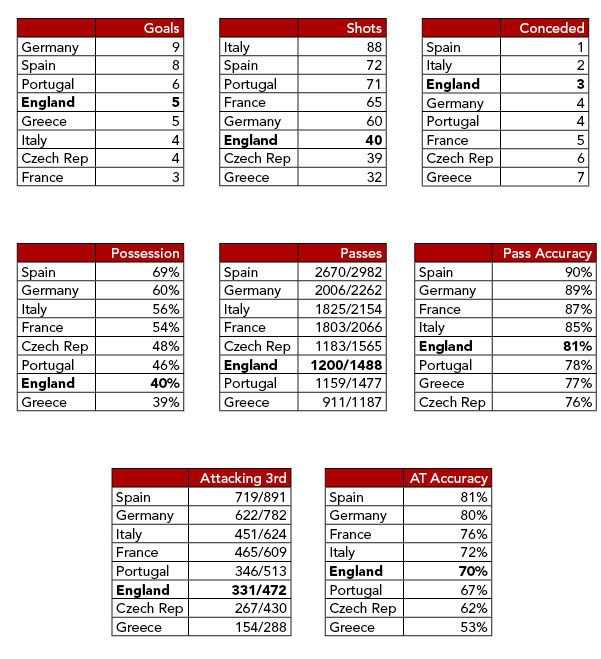
A handful of attacking statistics – combined totals after each's four matches – for the eight teams to qualify for the knock-out rounds seems an apt illustration of where England stands after the quarterfinals.


Congratulations, you're better than Greece and the Czech Republic! And a couple other countries in a couple of categories. Huzzah! It's no surprise to see Spain atop almost every category, except Germany have scored more goals (with far fewer shots) and Italy have taken more shots – which is explained by Italy's unfathomable 36 shots against England. Which is just four shots fewer than England took all tournament.

Unsurprisingly, England come off worst in possession, shots, and attacking third passes. And are above average in goals conceded. That's Roy Hodgson Football perfectly epitomized. And it's Hodgson Football when Hodgson Football works; Liverpool were assuredly below average in goals conceded, especially away from Anfield, during his reign.

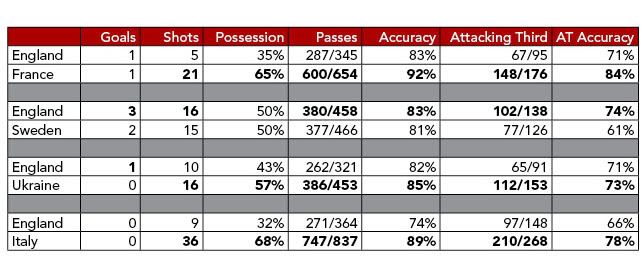
Comparing England to their opponents in each match makes for even grimmer reading.


France and Italy were better in each of these categories in the two matches England drew – ignoring the fact England actually lost to Italy on spot kicks. England were statistically better than Sweden in all of these categories save possession; Sweden only scored twice because of two out-of-character defensive errors. And England were better than the Ukraine in just one category: goals scored.

Hodgson and his apologists would argue that doesn't really matter, that it's a results-based game, and England only lost one match because of the penalty lottery. Which has some validity. Had Young's spot kick not hit the crossbar, had one more Italian missed theirs, England could still be unbeaten. Whether they deserve to be is a different question, but you often don't get what you deserve in sport.

However, the question remains whether that, and the above statistics, is good enough for England's national team. At the moment, the sad truth may be that it is.

Thursday, May 24, 2012

Minutes Played 2011-12

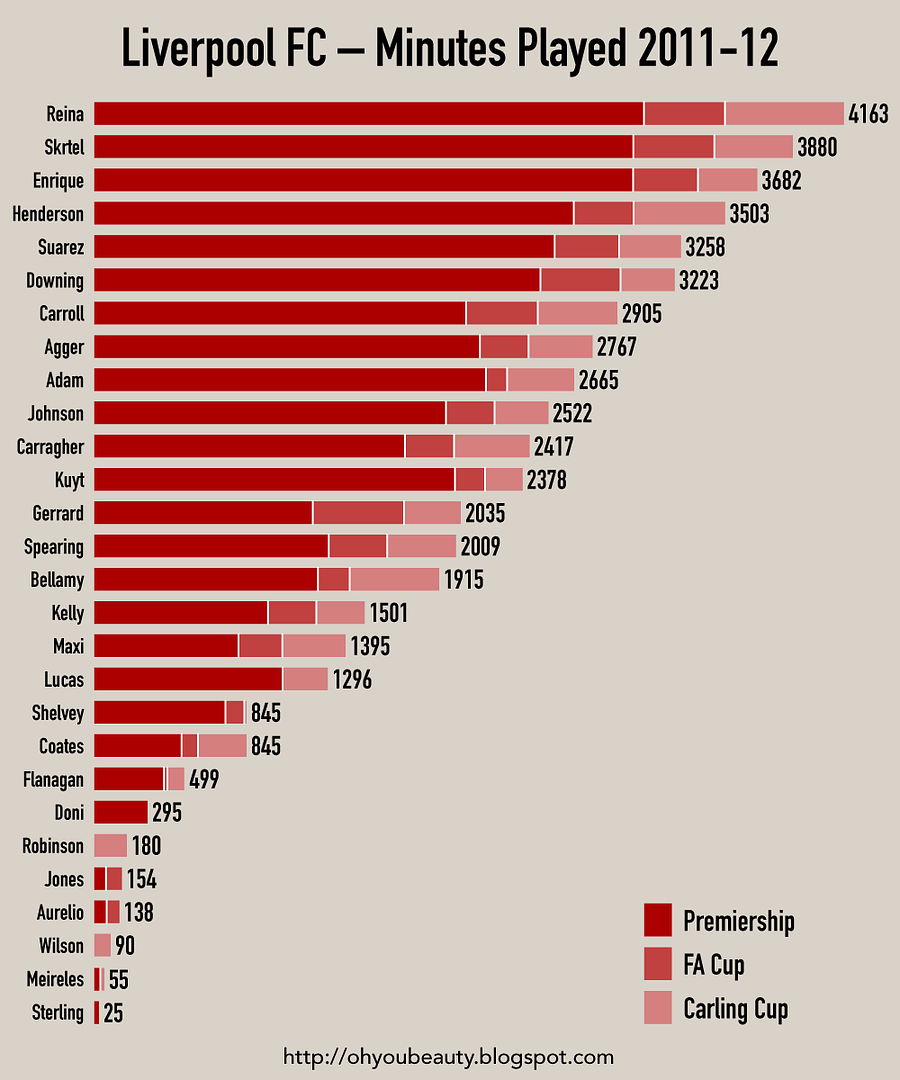
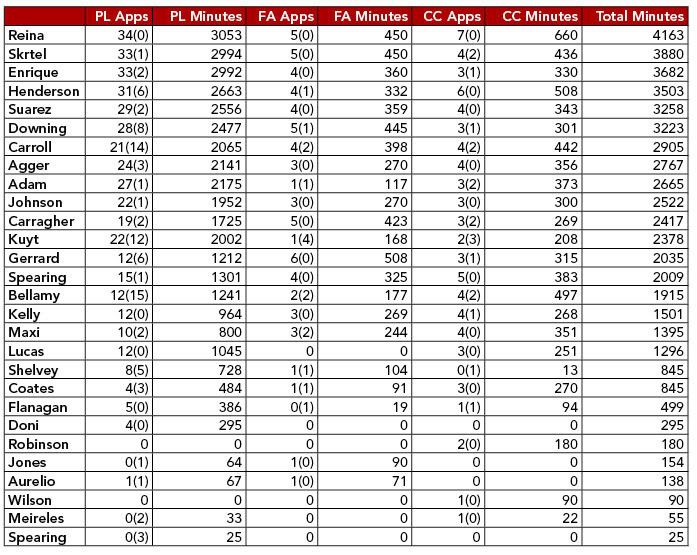
Had a request following the last graphic, which listed each players' total appearances, to break it down into minutes played. Appearances can be deceiving, after all. Ask and ye shall receive (sometimes).


Total possible minutes were 3420 in the Premier League, 540 in the FA Cup, and 660 in the Carling Cup.

Notable miscellany:

• Unsurprisingly, two defenders and the starting goalkeeper played the most minutes. It's no surprise to see Reina lead in minutes played for the Premiership and Carling Cup – he was the only player to play all seven Carling Cup matches and the maximum minutes possible in any competition. Both he and Skrtel played every minute in the Premier League last season. This was the first season since 2006-07 where Reina didn't play every Premier League minute.

• It was, however, slightly surprising to see Gerrard lead in minutes played for the FA Cup, the only player to start all six FA Cup ties. Carroll and Downing were the only others to appear in all six matches; Downing started five, Carroll four.

• Carragher played the fifth-most minutes in that competition, behind Gerrard, Reina, Skrtel, and Downing. However, he was 12th in Premier League minutes played and 16th in Carling Cup minutes played.

• Kuyt and Bellamy had the joint-most substitute appearances in all competitions, with 19. Carroll was just one behind, with 18 appearances off the bench.

• Despite being injured since the end of November, Lucas played just 99 minutes less than Maxi, with both making the same number of Premier League appearances. This should bother you. It bothers me.

• Somehow Shelvey and Coates played the exact same amount – 845 total minutes. I just found that odd.

Sources:
• Premiership totals from LiverpoolFC.tv statistics
• Cup totals added together from LFCHistory.net match reports

Monday, May 21, 2012

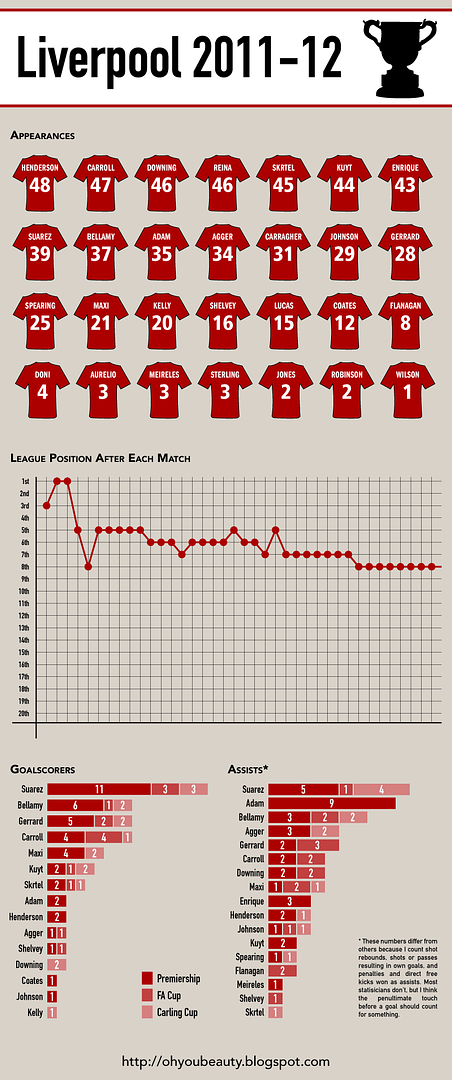
Liverpool Stats 2011-12

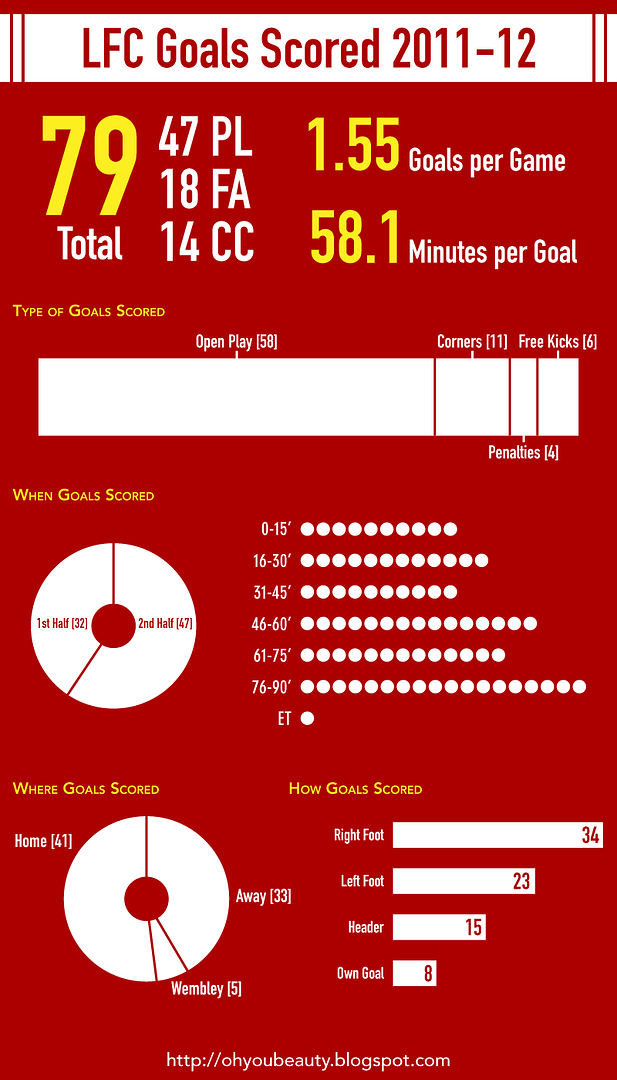
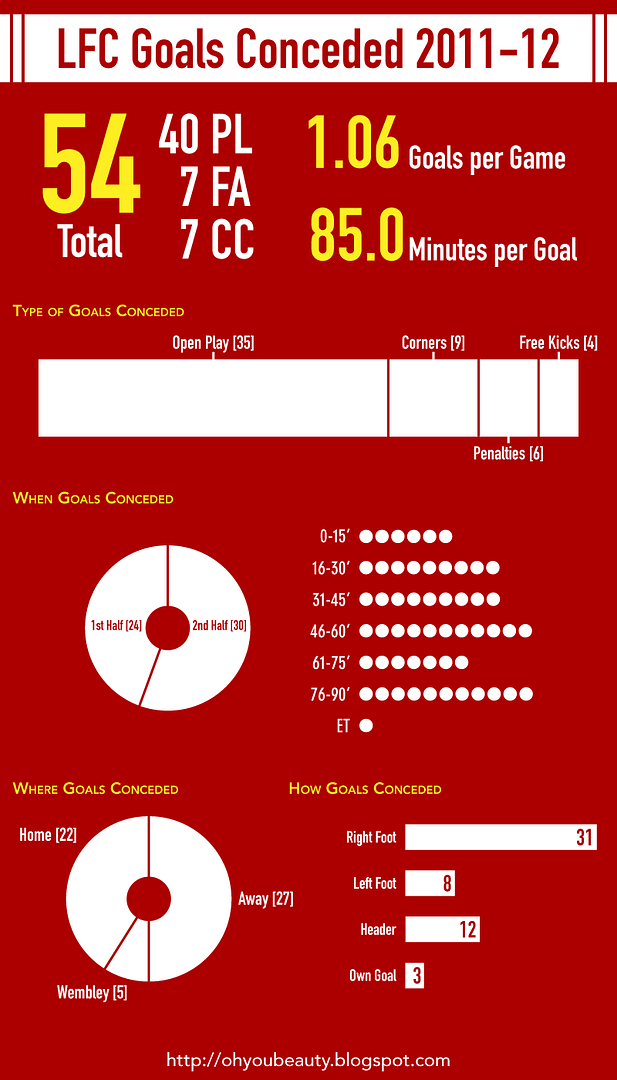
More season-long statistics in graphic form, similar to those about goals scored and conceded published last week. Because no matter how painful the 2011-12 season was, this is still more fun than baseless and mindless speculation about the new manager and/or future of the club.


As often, all statistics from LFCHistory.net except for "assists," which are explained in the graphic.

Wednesday, May 9, 2012

Painting the Woodwork


As many have noted since yesterday, Downing's two strikes against the woodwork bring Liverpool's league total to 33 for the season, a seemingly egregiously large number. Rubbing salt in the wounds, after the 0-1 loss to West Brom, Opta Joe noted that Liverpool would be fourth in the league if all the shots which hit the frame were goals. 10 of the 33 came in five of Liverpool's frustrating home draws, so there's 10 points right there.

The scapegoat list: Suarez 8; Downing 5; Carroll, Kuyt 4; Agger, Bellamy, Henderson 2; Adam, Kelly, Maxi, Shelvey, Skrtel 1. And one by Wright-Phillips for QPR in the 1-0 home match. 19 different Liverpool players have taken at least one shot in the league this season. 12 hit the post at least once. Coates, Gerrard, and Johnson are the only Liverpool players to have scored in the league without hitting the woodwork.

As distribution goes, it's fairly evenly weighted. 13 off the crossbar, 11 off the right post, and 9 off the left post. 8 of the 11 which hit the right post were aimed at the bottom half of the goal, 6 of 9 for the left post, showing that Liverpool consistently shoot low into the corner, which is fairly common and supported by these analyses from EPL Index and The Tomkins Times. Those which hit the crossbar were scattered across its length.

Shot placement data taken from StatsZone, this YouTube video, other random match highlights, and my admittedly faulty memory.

Monday, April 30, 2012

Better Performance, Worse Results

Saturday's match was pretty much all the proof we need. It really is all about finishing.

Liverpool have played "better" than they did against Norwich in numerous matches. And it's usually, somehow, led to worse results. Suarez tallied three world-class goals – and that term isn't used lightly – three superlative finishes, each more impressive than the last. Two will probably show up on the end-of-season Top 10 goals list. And that's the sole difference between the comfortable three points and yet another frustrating draw.

Otherwise, it was a fairly pedestrian performance from Liverpool, one which wasn't wholly unexpected given where we are in the season and what's come before. And admittedly, Norwich's poor defending played a role in two of the three goals, if not all three. But aside from those three spectacular strikes, Liverpool were typically profligate: a couple misses from Suarez, Shelvey's header off the bar and bobbled point-blank strike, Downing's right-footed shot smartly saved (not to mention the numerous blind alleys he ran directly down).

As always, statistics provide just a small snapshot, but here's a brief comparison with ten of Liverpool's most disappointing matches where they've played "better" but taken fewer points.


Fewer shots in nine of the ten – on target, off target, and blocked – and less possession in six of the ten. The differences in chances created – yes, that statistic again – is the most conspicuous. That statistic seemingly defined last summer's transfer business; we all remember the ubiquitous chart showing Adam, Downing, and Henderson in the top 10 for Premier League chances created. Well, this is where it's gotten us. And where it's gotten the architect of last summer's transfer business.

According to StatsZone, the source of all of these statistics, Liverpool have created 443 chances this season, an average of just under 13 per match. And have scored just 43 league goals. Which is the fewest in a season since 1776 or something. Liverpool created just eight chances against Norwich and scored three goals. None of those chances were clear-cut, by any definition. The team created fewer chances in just four league matches this season – 0-4 at Spurs, 2-1 at Chelsea, 1-2 at United, and 0-2 at Newcastle. And yet, Liverpool still won handily on Saturday against a side they frustratingly drew with at Anfield.

Yes, Liverpool have had other problems, repeatedly discussed at length here, there, and everywhere. Inconsistent performances, inconsistent tactics, questionable purchases, key players missing for long stretches. Everyone has their favorite scapegoat. Football is rarely explained by a singular success or failing.

Incidentally, Liverpool used a range of different formations and personnel in the above matches. 4-4-2 with Suarez and Carroll, 4-4-2 with Suarez and Kuyt, 4-2-3-1, 4-3-3, even 3-4-2-1. Carroll/Adam/Downing/Henderson have played well/poorly in wins, draws, and losses. Some matches saw egregiously unlucky own goals, egregiously stupid defensive mistakes, and/or penalties not given. Every attacker in Liverpool's line-up has missed chances in multiple matches, often by hitting the five-inch-wide frame of the goal. But when just one player's finishing is clinical – and Suarez was supremely clinical against Norwich – the rest of the attacking statistics don't really matter.

As wonderful as Suarez's match-winning display was, his time at Liverpool shows that we can't depend on it. He's a genius, but – like the rest of the side – an inconsistent genius, made more inconsistent by the audacious tricks he often attempts. He's had more and better opportunities in multiple matches and failed to take them. Against Norwich, his two easiest chances were the two chances spurned: his mis-kick of Downing's cross blocked in the six-yard-box and his chip over the keeper and bar after nutmegging yet another defender. There's a chance this display could prompt a run of form similar to his seemingly ever-present impact when playing for Uruguay, but chances are he remains frustratingly erratic. Similarly, his most-frequent strike partner has been better coming deep to win headers, setting up others rather than seizing on chances of his own. But again, everyone – everyone, everyone, everyone – is guilty of Liverpool's most despicable crime.

This is news to absolutely no one who's watched more than half-an-hour of any Liverpool match this season. I would like nothing more than for the Suarez-Carroll partnership to be dependably prolific, but on eight months of evidence (12 if you go back to last season), it's not happening. That doesn't mean Liverpool should sell either (I've made, and will continue to make Carroll excuses due to his age and Liverpool's set-up for the foreseeable future). But it should ensure that Liverpool's most important business this summer is to find a striker capable of consistently finishing all those created chances.

Wednesday, April 18, 2012

Jamie Carragher and Defensive Positioning

Consider this an addendum to Noel's depressingly unsurprising post on Liverpool's defensive statistics with and without Carragher over at Liverpool Offside.

The numbers speak for themselves, but I've seen multiple people (not in Noel's post, by the way) credit Liverpool's inferior record with Carragher to Liverpool having to play a deeper back line thanks to Carra's notorious lack of pace. It's become something of a pet peeve of mine, because answers usually aren't that easy.

So, using the available average position diagrams from the Daily Telegraph match reports [they're missing v QPR (without Carra), v Villa (with Carra), and at Blackburn (without), because they're the Daily Telegraph and refuse to make anything easy or sensical], I thought I'd see if that was the case.


The fullbacks seem to get forward slightly more without Carragher, especially on Carragher's side, but not incredibly significantly. All in all, the charts look relatively similar expect for the white-outlined circles denoting where Carragher was. So let's get rid of the fullbacks.


That's better. And yep, looks deeper. But, again, not as much as I expected. There's a wider range of average center-back positions without Carragher in the line-up, but more interesting than how deep they play is how close together they are. I suspect having both center-backs nearer to one another, which suggests they're working better as a unit, is more meaningful than how deep either defends.

There were two matches where Carragher played notably deeper than his defensive partner: against Bolton and Wolves. Liverpool won both. The deepest Liverpool's center-backs played came at Chelsea, without Carragher in the line-up; Skrtel's average position is nearly inside the penalty box. And yes, Liverpool won that game too. So please, let's stop the focus on how "deep" Liverpool's defense is. The above suggests that isn't the alpha or omega.

Carragher has a tendency to exacerbate multiple problems in Liverpool's defense. That he's played so often borders on the unforgivable, even if there are excuses for individual games (it's Everton, it's away from Anfield, etc, etc). But crediting problems to a single factor, such as others having to play deeper because of said lack of pace, is far too simplistic. And might not even be true. As with everything else in football, defensive positioning depends on multiple factors – the other defenders on the pitch and the opposition, most notably. Often, it's not how deep Liverpool's defense plays. Who plays may well be, though.

Wednesday, April 11, 2012

50 Years of Merseyside Derbies


There have been 217 Merseyside derbies in total. I limited this remembrance to the previous 122, those played in the last 50 years. Which is actually a handy dividing line, as Liverpool and Everton only met once between 1951 and 1962, in the '54-55 FA Cup (which Liverpool won), because of Everton then Liverpool's relegation to the Second Division. Since '62-63, the two clubs have played at least twice per campaign, with 22 cup ties joining the two seasonal fixtures.

And one club is obviously better than the other.

54 wins, 41 draws, and 27 losses pretty much speaks for itself. Liverpool have a better record in four of the six decades, and by some distance in the 1970s, 1980s, and 2000s. The only competition in which Liverpool doesn't have a winning record over Everton is the season-opening Charity Shield, where both have one win, one loss, and one draw (each club had custody of the trophy for six months following the draw, if you're wondering).

Liverpool have also faced Everton in four cup finals – 1981 and 1984 in the FA Cup, 1984 in the League Cup, and 1986 in the ScreenSport Super Cup (don't ask) – and won all four, albeit with a replay in the '84 League Cup Final. The Reds also won both FA Cup semi-finals against the Blues, in 1971 and 1977. In total, Liverpool have won more matches, scored more goals, kept more clean sheets (48 to 43), and incurred fewer red cards in Merseyside derbies.

It's too bad the past isn't perfect proof of the future. Although that might well be a good thing since Liverpool have failed to win the last five derby cup ties.

As usual, most stats from the irreplaceable LFCHistory.net, without which I wouldn't be able to do approximately half of the infographics I've created. Red card totals from Liverweb and the Merseyside Derby Wikipedia page (don't laugh), all between 1979 and 2011. In theory, there could have been red cards in the derbies from 1962-78, but I couldn't find evidence of it.

Wednesday, April 4, 2012

2011-12 Turning Points


Lucas Injury
• 1.77 points per game before, 1.05 after [-0.62 PPG]
• 1.31 goals per game before, 1.05 after [-0.26 GPG]
• 0.92 goals conceded per game before, 1.11 after [+0.19 GCPG]

Suarez Suspension
• 1.72 points per game before, 1.40 during [-0.32 PPG]
• 1.17 goals per game before, 1.40 during [+0.23 GPG]
• 0.78 goals conceded per game before, 1.40 during [+0.62 GCPG]

Carling Cup Final and Agger Injury
• 1.56 points per game before, 0.50 after [-1.06 PPG]
• 1.16 goals per game before, 1.17 after [+0.01 GPG]
• 0.92 goals conceded per game before, 1.67 after [+0.75 GCPG]

All three are terrifying, but the effects of the Carling Cup final hangover and, more importantly, Agger's injury are by far the scariest. Liverpool have only played six league matches since, but are averaging a point less per game and conceding 0.75 more goals per game. Having Johnson and Kelly absent for most of those certainly hasn't helped, but Agger is the the biggest miss. Skrtel may have been Liverpool's player of the season – at least before this recent stretch – but Daniel Agger is by far Liverpool's most important defender. As Bass Tuned to Red wrote earlier this week, Liverpool have conceded a league goal every 129.7 minutes with Agger on the pitch, and a league goal every 58.9 minutes when he has been absent. Yikes.

Lucas' injury is almost as significant. Liverpool's record in the 13 games prior to his injury: 6W-5D-2L. Liverpool's record in the subsequent 18: 5W-4D-9L. Fewer goals scored per game and more goals conceded, although it's slightly surprising to see a bigger difference in goals scored rather than conceded. But Lucas' as the metronomic base for Liverpool's attacks is just as important, if not more so, than Lucas as the tough tackling defensive midfielder.

Finally, Suarez's suspension. Five matches, from Newcastle at home through Wolves away, returning as a substitute against Tottenham. Liverpool actually scored more goals per game during the matches Suarez missed. Carroll started as a lone striker in three: the two matches where Liverpool scored three – wins against Newcastle and Wolves – as well as the 0-3 loss at City. Carroll and Bellamy partnered in the loss at Bolton, linking up for the lone goal, while Kuyt started up front in the 3-4-2-1 scoreless draw against Stoke. However, Liverpool's goals conceded tally rose dramatically during that span, mostly thanks to conceding three against City and Bolton, both featuring Liverpool's first choice back four of Johnson-Skrtel-Agger-Enrique. It's hard to credit that to Suarez's absence, but I suspect (without proof) that opponents are more hesitant to send multiple attackers forward with the ever-dangerous Uruguayan lurking off the shoulder of the last defender.

Missing key players for long to extra-long stretches isn't a good enough excuse for this season's horrors. Liverpool still scored too few goals, conceded frustratingly in aberrant draws, and found new and inventive ways to drop points before any of these three turning points. However, all three absences, as well as the post-Carling Cup letdown, do help explain the increasingly diminishing returns during this horror campaign.