Showing posts with label Ingerlund. Show all posts

Monday, June 25, 2012

England at Euro 2012 (Statistics)

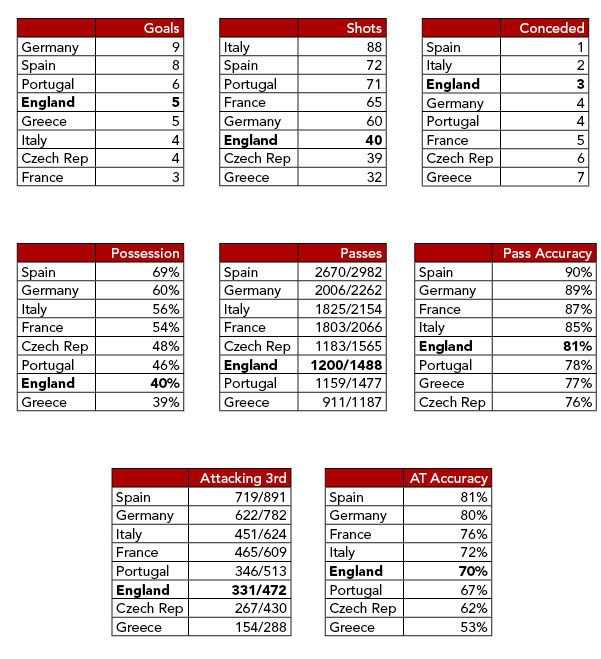
A handful of attacking statistics – combined totals after each's four matches – for the eight teams to qualify for the knock-out rounds seems an apt illustration of where England stands after the quarterfinals.


Congratulations, you're better than Greece and the Czech Republic! And a couple other countries in a couple of categories. Huzzah! It's no surprise to see Spain atop almost every category, except Germany have scored more goals (with far fewer shots) and Italy have taken more shots – which is explained by Italy's unfathomable 36 shots against England. Which is just four shots fewer than England took all tournament.

Unsurprisingly, England come off worst in possession, shots, and attacking third passes. And are above average in goals conceded. That's Roy Hodgson Football perfectly epitomized. And it's Hodgson Football when Hodgson Football works; Liverpool were assuredly below average in goals conceded, especially away from Anfield, during his reign.

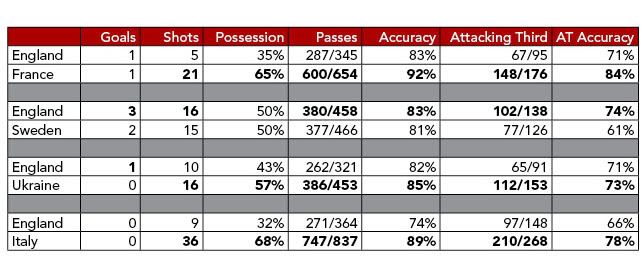
Comparing England to their opponents in each match makes for even grimmer reading.


France and Italy were better in each of these categories in the two matches England drew – ignoring the fact England actually lost to Italy on spot kicks. England were statistically better than Sweden in all of these categories save possession; Sweden only scored twice because of two out-of-character defensive errors. And England were better than the Ukraine in just one category: goals scored.

Hodgson and his apologists would argue that doesn't really matter, that it's a results-based game, and England only lost one match because of the penalty lottery. Which has some validity. Had Young's spot kick not hit the crossbar, had one more Italian missed theirs, England could still be unbeaten. Whether they deserve to be is a different question, but you often don't get what you deserve in sport.

However, the question remains whether that, and the above statistics, is good enough for England's national team. At the moment, the sad truth may be that it is.

Sunday, June 24, 2012

England 0-0 Italy aet

Italy wins 4-2 on penalties

Penalties
Italy: Balotelli, Montolivo, Pirlo, Nocerino, Diamanti
England: Gerrard, Rooney, Young, Cole

Sometimes there is justice in the universe. Also, don't name your male children "Ashley."

Negative football doesn't get punished often enough. And Italy, for all its possession and passing supremacy, were unable to punish England through 120 minutes. But, as usual, penalties punish England.

England made this Italy side – better than expected, decent but unimpressive – look like Spain. The first 15 minutes ended up an aberration, with England surprisingly attacking after De Rossi's early left-footed thunderbolt hit the post. Buffon somehow prevented Johnson from opening the scoring in the 5th minute, palming away the close-range effort after a nice move down England's right, Parker shot narrowly wide from the top of the box, and stellar defending from Barzagli and Abate prevented Welbeck and Rooney from getting off decent efforts. After that, it was pure HodgeBall.


Two deep lines of four coupled with a complete refusal to press the ball outside the final third. By half-time, Italy had 235 touches in the middle of the pitch to England's 79.

The most galling feature was how much license England gave Andrea Pirlo. Already one of the players of the tournament and, at age 33, a man whose abilities are well-documented, handed all the time in the world to create whatever he pleased.


Meanwhile, Gerrard couldn't make anywhere near the same impact for England, whether due to Hodgson's tactics or an inability to play four matches in 13 days. Or a combination of both.


I'm well aware he's the captain, and he'd have to be dragged from the pitch kicking and screaming, but it's criminal that Gerrard's played all 300 of England's minutes, including 120 today. To be fair, it's not as if England had many other options. And Hodgson had used all three substitutions by the 94th minute – even though Gerrard began showing signs of cramp in the 70th – first replacing Welbeck and Milner with Carroll and Walcott, then Henderson for Parker soon into extra-time, due to that player's long-standing injury. Carroll's entrance helped, more influential than the peripheral Welbeck, but removing Milner – whose stamina is his best attribute – was questionable at best.

So, how did England even stay in this match?


Last ditch defending. 13 blocks is the most from any side so far this tournament. Pack the penalty area, and make sure nothing comes cheap or easy. Which is Hodgson's trademark.


Last ditch defending and wasteful Italian shooting. Italy seemed satisfied to fire from long distance, unable to penetrate England's parked bus. Balotelli and Cassano's radars were off all match long, while England got reprieves as Balotelli (multiple times) and Montolivo missed clear cut chances. Diamanti hit the post in extra time, while Nocerino had the ball in the net in the 115th minute but was rightfully ruled offside.

Which meant that Hodgson's tactics "worked," with England making it to the penalty lottery. And it initially looked likely to pay dividends, as Gerrard and Rooney both tallied while Montolivo missed Italy's second. Then Pirlo stepped forward. His Panenka was a back-breaker, a psychological death knell, and a wonderful capstone for a wonderful player's wonderful match. Young and Cole missed England's next two penalties – the former off the crossbar, the latter easily smothered by Buffon. Nocerino, then Diamanti sealed qualification to the semi-final, yet another crushing penalty defeat for England – their seventh in the last eight attempts.

It's tempting to say "we told you so," but we told you so. This is Hodgson, for good and evil. It's ugly, it's dismal, it's overly defensive. But sometimes it works, and it also led to a better-than-expected result, a result England haven't bettered since the 1996 Euros on home soil.

Is it a long-term solution? Absolutely not. And it's indescribably painful when done without any improvement in results, as Liverpool learned. But sometimes you need your short-term medicine.

Still, I'd recommend it remain nothing more than short-term medicine.

Tuesday, June 19, 2012

England 1-0 Ukraine

Goals:
Rooney 48'

Controversy! Drama! Mostly crap football! Never change, England. Never change, UEFA.

Rooney returned, our savior, in place of Carroll as the only change from last match's XI. And Ukraine were dominant in the first half, with Hodgson's side unsurprisingly content to invite the opposition on and hope to keep it tight, play for the draw and maybe, hopefully, somehow score on the counter or from a set play. Nine shots from the hosts to just four from England, but all but one Ukraine shot off-target, most from distance. Rooney had England's lone decent opportunity, but headed a sitter wide midway through the frame, clearly coated in a thick layer of rust.

The hoped-for England's goal came soon after the restart, and from a set play. Gerrard's corner initially cleared, picked up by Glen Johnson and returned to the captain, clever footwork to beat the closing defender, a dangerous right-flank cross twice deflected then spilled by the keeper, easily tapped in by the returning conquering hero at the far post. Don't be surprised when Rooney gets all the credit for a goal any of us could have scored.

Let's get to the fun stuff. Namely, this:


Even with this grainy, television screen capture, you can see the ball's over the line. Ukraine stormed down the left after a long ball from Selin, with both Terry and Lescott caught behind the strikers they were marking. Milevskiy laid off for Dević, who danced around Terry then fired a shot which squirmed under Hart's save, somehow cleared out of the goal-mouth by England's Brave JT. But cleared after it crossed the line.

To be fair, the extra officials behind the goal have made a difference. There has been far less Greco-Roman wrestling by agricultural center-backs and better decisions on corners or goal kicks. On the whole, they've been a valuable addition; an extra set of eyes is usually helpful. This one just did his job terribly today. Now resumes the all-consuming chorus for goal technology. Well, probably not quite all-consuming. The furor after Lampard's World Cup "goal" against Germany was all-consuming. Furor tends to be less all-consuming when it benefits England.


The official behind the goal wasn't the only negligent official today, joined in idiocy by the linesman on that side of the pitch. Not only was Milevskiy offside in the build-up to the controversial no-goal, he was also offside a minute earlier when missing an easier header than Rooney missed. Neither saw the linesman raise his flag. Well done. Idiocy loves company.

After that second stomach punch, Ukraine were never likely to find the two goals they needed to qualify. Hart was tested just once more, wonderfully parrying Konoplyanka's whirling, weaving, diving 35-yard rocket in the 73rd minute, cleared out of the six-yard-box by Lescott. But the scrambling, everything-including-the-kitchen-sink ending suited England just fine. 12 of the Ukraine's 16 shots came from outside the box; only the aforementioned Konoplyanka effort was on target. Shevchenko, left out of the starting line-up due to injury, couldn't conjure a miracle as in the first match. Walcott, Carroll, and Oxlade-Chamberlain came on to give England fresh legs, and England saw out its lead like Hodgson's West Brom or Fulham, not Hodgson's Liverpool.

Once again, and not just because of my overwhelming Liverpool bias, I have to single out Steven Gerrard's performance.


Technically, StatsZone aren't crediting Gerrard with an assist – possibly because of the deflections, possibly because of the keeper's howler – but that goal was created by Gerrard. As were three other chances, more chances created than any other England player. Another supremely disciplined central midfield performance, and four more tackles than holding midfielder supreme and press corps favorite Scott Parker – tackles which came on both flanks, helping demonstrate the defensive effort he put in. He has been England's best player in all three matches, provided assists for three of England's five goals, and has either scored or assisted on five of England's last eight tournament goals. It has been a true captain's tournament, and I'm sure there's absolutely no coincidence that it's happened with Frank Lampard nowhere in sight.

The Hodgson Express steams on to Italy. France's complete failure against Sweden means England avoid Spain, at least for now. Once again, it wasn't pretty by any possible definition, but it worked. That counts for something, as much as I dislike crediting Hodgson for anything except disease, famine, and other assorted evils. But whether that will suffice against Italy, or any of the other sides left in the competition for that matter, remains a much tougher question.

Friday, June 15, 2012

England 3-2 Sweden

Goals:
Carroll 23'
Johnson (OG) 49'
Mellberg 59'
Walcott 64'
Welbeck 78'

That just happened.

A mostly sterile first half marked by a singular moment of excellence. A full-blooded, wholly frenetic second half where England looked to have thrown away its slight advantage with abhorrent individual mistakes only to come storming back through Hodgson's inspired substitution. Hodgson. Inspired. Oh, and that substitute was Theo Walcott.

Hodgson reverted to a standard 4-4-2 – Carroll and Welbeck took turns dropping off, Gerrard and Parker took turns going forward – while Sweden were more 4-4-1-1 with Ibrahimovic trying to link attack and defense.

England's Made in Liverpool opener was the only highlight in a fairly dull first 45 minutes. Midway through the half, Gerrard popped up on the right and delivered a sumptuous cross, met perfectly by Carroll's kangaroo jump, unstoppably headed past Isaksson. This picture, via @DanKennett, shows how well Carroll rose over Mellberg and Granqvist. More of that, please.


Otherwise, Parker had an early shot supremely saved by Isaksson – one of the few obviously good things the holding midfielder did today – while Young shot into the side-netting when put through late in the half. Meanwhile, Sweden were wholly limited to shots from distance, some on-target but few threatening, with England's deep back line plugging most of the holes.

That all went out the window in the second half, with England going from comfortably ahead – as comfortable as England can ever be with a one-goal lead – to behind before the hour mark. Both goals came on set plays, both attributable to individual scapegoats.

Unfortunately, Glen Johnson was the first – unduly harsh given his otherwise impressive performance. Ibrahimovic's free kick thundered harmlessly into the wall, but the iconoclastic striker kung-fu kicked back toward goal. Johnson not only played Mellberg onside, caught flat-footed after the initial block, but saw Hart's save from Mellberg's shot ricochet off him and was unable to prevent it from squirming over the line. To compound matters for Liverpool fans, the free kick was sloppily conceded by Carroll, trying too hard to impress in defense with a clichéd center forward's tackle.

Unsurprisingly, the equalizer gave Sweden the momentum, and – dominating possession for the next ten minutes – England's frequent nemesis went ahead from another free kick. This time, the other full-back was mainly at fault, again with fingers also pointed in Johnson's direction. Larsson crossed from the left flank and Ashley Cole bafflingly froze, leaving Glen Johnson marking three Swedes. If England were marking zonally, it was for the first time. And, mostly likely, the last. It was little surprise to see Mellberg (yep, him again) leap highest.

Unlike so often during his Liverpool tenure, Hodgson responded immediately, replacing Milner – who conceded the free kick for the second goal and was otherwise typically Milnerrific – with Walcott. Three minutes after his introduction, England were level.

Terry nearly scored seconds earlier, his bullet header from Johnson's cross somehow saved by Isaksson. The resulting corner was initially cleared, but cleared straight to Walcott. Isaksson had to have been unsighted on the subsequent shot, straight down the center of the goal with the keeper stumbling, waving, and nowhere close to the strike.

Which set us up for a rollicking, straight-out-of-the-Premiership, end-to-end frenzy. Källström blazed over after an incisive slalom from Martin Olsson. Hart saved Ibrahimovic's swerving missile from the top of the box. Then came Danny Welbeck, with another sterling cameo from Walcott. A quick transition from attack to defense, shifting gears with Gerrard's pass to Johnson in space on the flanks. A lay-off to the Arsenal forward, a blistering run to the byline between Larsson and Jonas Olsson and a cross behind Welbeck, who somehow spun onto the ball, back-heeling a flick around Isaksson nestling into the far corner. Clever, impudent, audacious; choose your effusive adjective. I rarely link goals here, but this one's unavoidable.


From there, it was a matter of holding on – always a tougher challenge than it should be for England and for Hodgson's sides – but England had the best chance of the final minutes, with Gerrard unlucky not to get a goal of his own, denied by Isaksson on the break, sweetly hitting a volley but selfishly hitting that volley in front of a better-placed Oxlade-Chamberlain. No matter.

As FourFourTwo wrote after the game, England and Sweden were very similar in passes and shots. 50-50% possession, each with 13 shots, only eight fewer passes attempted by the Swedes.

The difference was in the finishing and the crucial substitution. And, for once, in England's mentality.

England had never beaten Sweden in a competitive fixture; a handful of friendly wins between 1923 and 1968, and the 1-0 Wembley win last November, but five draws and two losses when it actually mattered. And England are rarely known for storming comebacks, or tepid comebacks or comebacks in general. But here we are.

Walcott deserves man of the match and every one of the plaudits he'll receive – the difference-maker for England for the first time since his Croatia hat-trick almost four years ago. On the pitch for just over 30 minutes, in possession for just 17 seconds, five out of five passes successful, two out of two crosses successful, a goal and assist, and nearly a second assist on Gerrard's late chance. But I'd be remiss if I didn't also single out the captain, who put in a wonderfully diligent, disciplined display.


I've often questioned Gerrard's ability to play as an out-and-out central midfield in a 4-4-2 pairing. He's obviously done it before, and done it well, but he's failed to do it enough of the time during Liverpool's frequent struggles over the last few seasons to the point where it's become a contentious issue. It was not a contentious issue today, keeping his position and possession, limiting the maligned Hollywood passes, and making an impact on the few occasions where he bombed forward, which he did with increasing frequency as the game went on. And that was all while carrying Scott Parker on his back for 90 minutes.

Level on points with France, one behind on goal difference, England now just need a draw to advance to the knock-out rounds. But with second place in Group D likely to face Spain in the quarterfinals, I doubt England will play for the draw, even considering this team's strengths and this team's manager. Meanwhile, the French face the already-eliminated Swedes. And Ukraine, just one point behind England, assuredly won't go gentle into that good night.

I'm duty-bound to warn we've been burned in the past. Optimism is always, forever a dangerous thing for England fans to have.
Monday, June 11, 2012

England 1-1 France

Goals:
Lescott 30'
Nasri 39'

Welcome to the Roy Hodgson Era. A defensive set-up, limited ambition, a set play goal, and two solid lines of four retreating deeper and deeper as the match went on. England's full-backs mostly stayed in their own half, England's wide players rarely got ahead of the two out-and-out attackers, and Gerrard charged forward from deep to join the attack maybe twice. England were out-passed, out-shot, out-possessed, and out-thought, but earned a famous draw because the defense bent and broke just once.

To be fair, playing for the draw in the first match, against the toughest opponents in the group, makes sense. Mostly defensive football with the players England have, especially with the numerous injuries and Rooney's suspension, makes sense. And I'm admittedly prejudiced by Hodgson's insipid Liverpool tenure. International football, even more than club football and especially in major tournaments, is defined by the smallest margins. But France weren't especially impressive either, with little to make them look like a team that's now gone 22 matches without a loss.

England probably should have been two goals ahead by the time France clicked into gear. 15 minutes in, Milner was clear on goal, played between a wide-apart Rami and Mexes by Young's throughball, but took the ball too wide after rounding Lloris and shot wildly into the side-netting. 15 minutes later, England were ahead, typically from a free kick – a soft foul on the right flank, perfect out-swinging delivery from Gerrard, and Lescott out-jumping Diarra, guiding his header past a starfish Lloris.

But the goal woke France up. Diarra nearly made amends with his own set play chance, with Hart brilliantly stopping his fierce header, followed up by a second attempt put wide. England's reprieve didn't last long as two full minutes of French possession (aside from one hoofed Milner clearance) ended with Nasri's blistering goal from distance. It was an excellent shot, powerful enough to beat Hart at his near post with little blame for the keeper, but the manner of concession was incredibly demoralizing. Nasri (and Cabaye) had acres of space at the top of the box as both Gerrard and Parker followed Ribery into the penalty area. Neither center-back marked any French player. England had nine players in the penalty box while France had three. Seriously, can anyone explain this picture?


Thankfully, that was the only clear failure, able to be written off as a singular moment of madness. But from there, it was even more typical Hodgson and typical England. A slight improvement after the interval, with increased possession lacking in threat followed by French domination after the hour mark. Only one side looked capable of winning the match, only one side looked bothered to win the match. But other than that moment of total madness in the 39th minute, England defended well, in open play and from set plays, especially Glen Johnson, who's often (wrongly) maligned for supposed defensive deficiencies. England blocked the shots they needed to block, Lescott and Terry won the aerial duels they needed to win, and Hart made the saves he needed to make when called upon. Job done? Well, it depends on your job description.

The statistics make for terrifying reading, and will prove to the French that they should have taken more from this. 65% French possession. 21 shots to England's five. 11 corners to 4. Most frighteningly notable was the discrepancy in passes.


The total number of passes is frightening, as is the respective completion percentages (92% to 83%), but the difference in quantity and quality of attacking third passes sticks out like a sore thumb. Compare how many French attacking third passes started in their own half to those from England. It's not pretty, not as a chalkboard and not as a spectacle. But England never promised or threatened pretty football. In fact, they promised the diametric opposite.

Again, and not to keep banging the same, tired drum, but we shouldn't have expected much more, not in this match and not from this team or manager. England should assuredly attack more and better in its next two matches, against Sweden then co-hosts Ukraine. If they done, then the howls of condemnation will follow. This draw decides little, which seemed partly the goal. The success or failure of this campaign will be determined by how England play in matches where they're the clear favorite.

Monday, June 4, 2012

Liverpool FC and the English National Team


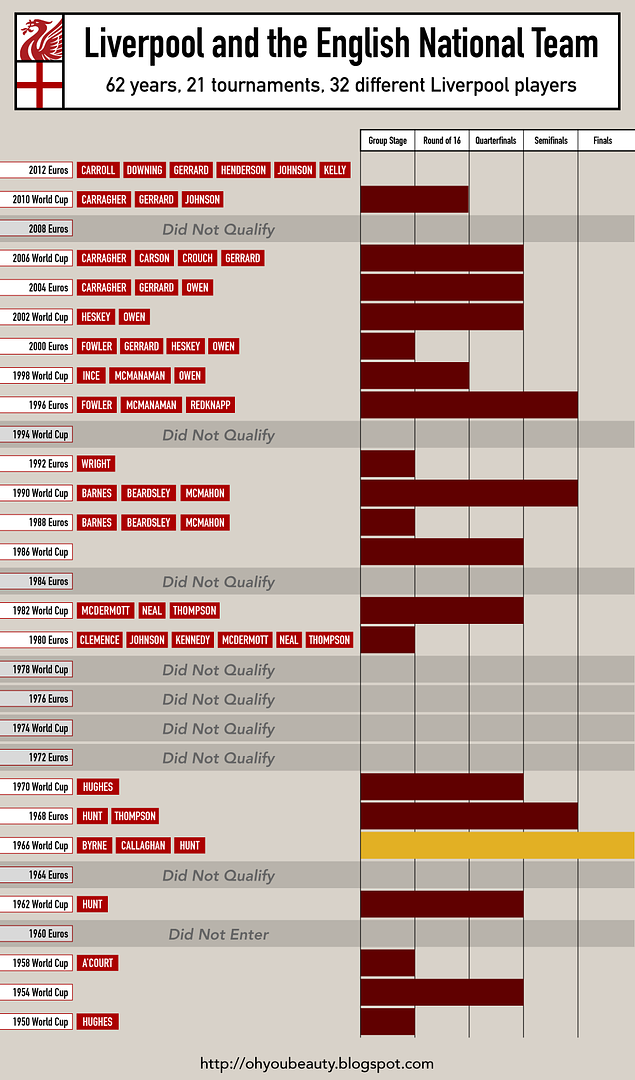
• England have qualified for 21 of the 30 World Cups (13 of 16) and European Championships (8 of 14) held since 1950. Liverpool had at least once player in 19 of the 21 England squads. On average, Liverpool have had 1.92 players involved in an England World Cup squad and 3.5 in a Euros squad.

• One of those two tournaments where Liverpool had no players in the England squad was the 1954 World Cup, which took place just after the last time Liverpool were relegated. The other was the 1986 World Cup. In contrast to 1954, Liverpool won the league prior to that tournament. To be fair, Steve McMahon (first cap in 1988), Sammy Lee (last cap in 1984), and Paul Walsh (last cap in 1984) were the only English internationals at the club then (both Alan Kennedy and Phil Neal left Liverpool during the '85-86 season).

• I can't help but think Hodgson's taking so many Liverpool players as a form of punishment. With Kelly added to the England squad on Sunday due to Cahill's fractured jaw, the 2012 Euros squad equals the record for most Liverpool players in an England squad, set in the 1980 European Championships. Just as in 1980, no club has more in the English squad. Granted, Liverpool won the 1979-80 league championship while finishing 8th this season, so that probably doesn't bode well for the Three Lions. If you're wondering, England finished third in its group in the eight-team 1980 Euros, behind Belgium and Italy (but ahead of Spain!). All six Liverpool players featured in the first match, a 1-1 draw against Belgium, but only Phil Thompson played in all three matches.

• Liverpool have been the best-represented club six times: joint-top four times (2006 with Chelsea, 2000 with Manchester United, 1982 with Ipswich and Manchester United, and 1966 with West Ham and Manchester United), and with the outright most England players in the 1980 and 2012 Euros.

• Technically, England's 1982 World Cup campaign ended at the Second Group Stage, with 12 sides remaining, rather than the quarterfinals, finishing second in their three-team group behind West Germany. But I really didn't want to create a "Second Group Stage" category for just that tournament.


(ht Inter Leaning for the photo, from the 1966 World Cup Final)