Showing posts with label Fun with Infographics. Show all posts

Monday, September 3, 2012

Visualized: Liverpool 0-2 Arsenal

Previous Match Infographics: Manchester City (h)

Well, I promised to do these comprehensive infographics for all the "big" matches. I guess I can't stop after one because the second big match went so comprehensively awful. And no, I still haven't come up with a better title for the series.

As with last week's, all data via StatsZone and Squawka.

A couple of notes after the image...


This graphic seems to serve even more of a purpose than last week's against City. Because it makes it obvious how Arsenal won the game: midfield passing, a sturdy defense, and taking its chances.

Liverpool attempted and completed more passes – and a higher percentage of passes – and had more possession, but Arsenal's midfield put Liverpool's to shame. Arteta and Diaby controlled the game, while it felt like Cazorla could score or create a goal every time he waltzed into the final third. 72 passes, 65 completed is an egregious, egregious total for an attacking midfielder and again helps demonstrate just how much Liverpool missed Lucas' ability to cover that area of the pitch.

The tackles and interceptions section is almost as frightening. Especially as you near the penalty boxes. Arsenal's is ringed and filled with tackles and interceptions. Liverpool made one tackle inside its box and three inside the defensive third; nine of Liverpool's 17 tackles came in the opposition half.

Finally, every outfield Liverpool player – all 12 of them, starter and substitute – took at least one shot or created at least one chance. But once again, Liverpool wasted every single one. Seven of Arsenal's 13 outfield players created a chance or took a shot, but they made two of theirs count.

Monday, August 27, 2012

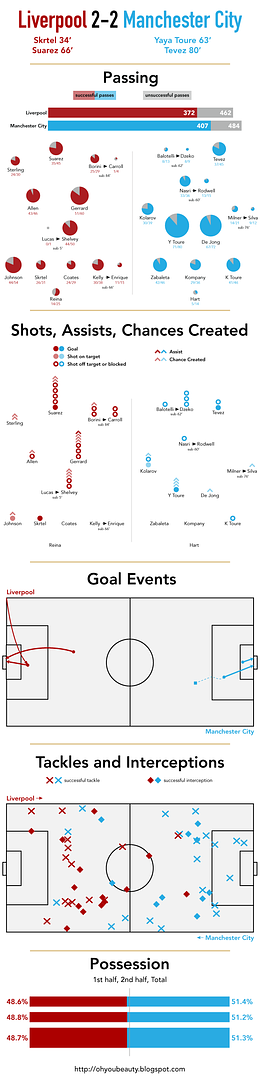
Visualized: Liverpool 2-2 Manchester City

The idea for this style of comprehensive infographic is from the incredible On Goals Scored, who did similar for the Euro 2012 final. All statistics sourced from StatsZone and Squawka.

My goal is to do this type of graphic for all the "big matches" this season – although I'm not yet willing to define "big matches" yet, as these take a fair amount of time to put together.


Friday, August 10, 2012

On Craig Bellamy and Squad Turnover


With the summer departures of Bellamy, Kuyt, and Aurelio (as well as Maxi and Aquilani), Liverpool now have just six players who have been on the books since the 2007-08 season: Carragher, Gerrard, Reina, Agger, Lucas, and Skrtel. Just six of the 27 players who have made at least first team appearance for Liverpool.

59% of the above players have joined since August 2010. 11 of the 27 – 41% – made their debuts after FSG bought the club in October of that year. Only six Benitez signings remain on the books, seven if you count Jonjo Shelvey – who made his debut under Hodgson.

The above is an update on this graphic, done following the 2010-11 campaign. It is not quite as striking – 12 of the 29 players on that chart joined that season – but still sufficiently demonstrates how heavy Liverpool's squad turnover has been in the last three years. And a handful of players on the above chart may well have little time left at club: Doni, Eccleston, Pacheco seem the most likely, but Cole, Carroll, and even Agger could well join them.

It's sad to see Craig Bellamy depart when there was still a clear role for him in the squad. It's hard to begrudge him a move back to Cardiff at this stage of his career, for family and personal reasons, but I also rue never seeing him line up with Suarez and Borini, a buzzing beehive front line that would torment any defense in the world. I can't help but prefer snarling, win-at-all-costs players, and Bellamy was an archetypal one in both of his Liverpool stints, the sort you love to have on your team and absolutely hate when they line up for the opposition.

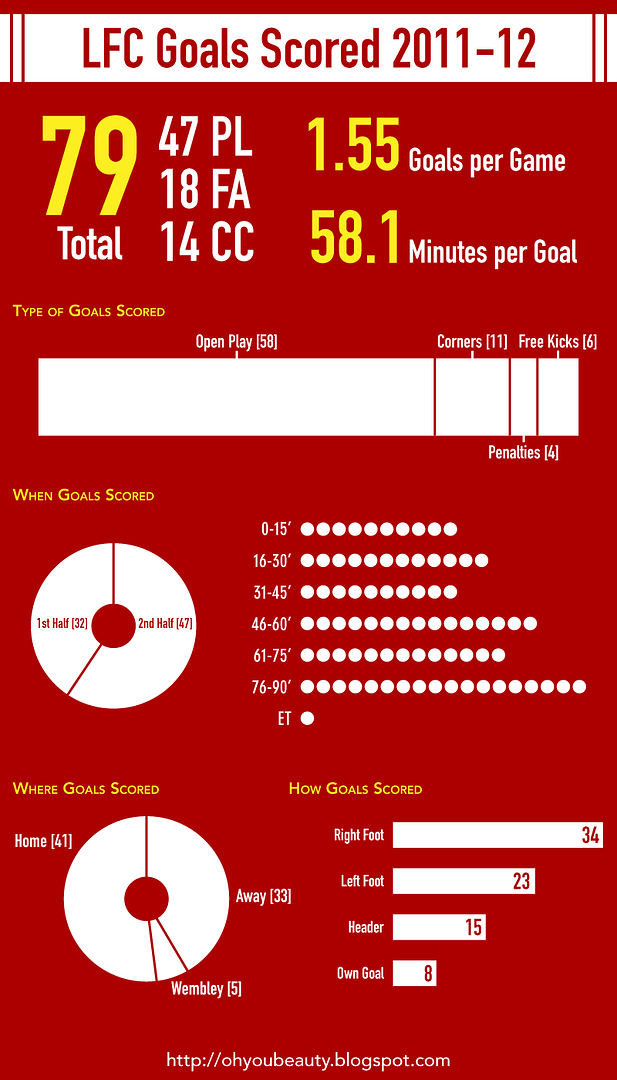
With Bellamy's exit, Liverpool have now sold 25% of last season's goals. 79 were scored; Bellamy tallied nine (which was joint-second along with Gerrard and Carroll), Maxi six, and Kuyt five. If Liverpool find someone who'll pay anywhere in the region of £20m for Andy Carroll, that number will jump to 37% when including Carroll's nine goals. Bellamy also contributed seven assists last season – third-most in the squad – while Maxi had four (if you include the penalty won against Oldham), and Kuyt two. Combined, Maxi, Kuyt, and Bellamy played 5688 minutes last season, and Fabio Borini can't cover all those minutes by himself.

Liverpool's lack of depth at wide forward seemingly remains the biggest hole in the squad. Supposedly, Joe Allen will join the club sooner rather than later, maybe even later today. While he'd be an excellent, welcome addition to the squad, central midfield is far less of a problem area than the flanks. Right now, Suarez, Borini, Downing, Sterling, and Cole are Liverpool's only wide forwards, with one of Suarez or Borini more likely to play as the central striker more often than not. That's far too few; it was one of Liverpool's weakest areas last season, even before the exits of Kuyt, Maxi, and Bellamy.

Cult heroes, fan favorites, and scorned wastes of space have all left the club in the last 12 months, in the last two months. More are likely to follow. Hopefully, they'll be replaced by younger, faster, stronger, better. That's always the hope, but never a certainty in the transfer market. Every manager, good and bad, has both hits and misses.

But this turnover further reinforces the notion that it truly is Year Zero. By design. Yesterday's wondrous, gratifying thrashing of FC Gomel demonstrated the potential this new era has, but Craig Bellamy's departure today reminds that this potentially wondrous squad remains painfully shallow.

Tuesday, July 10, 2012

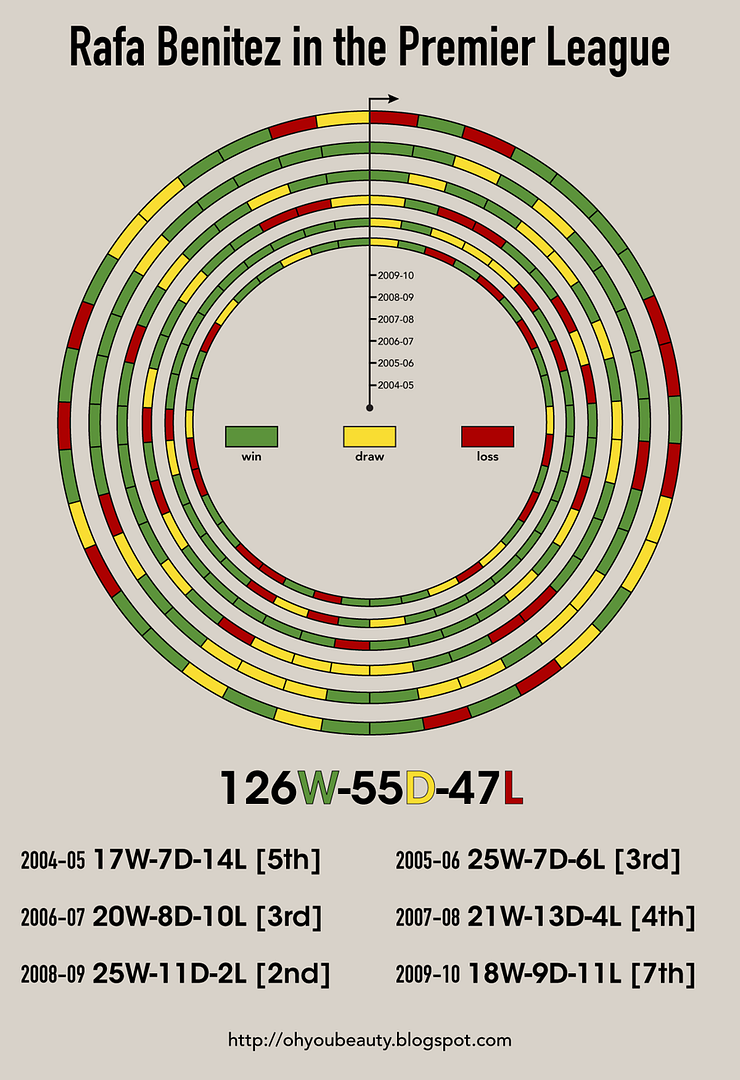
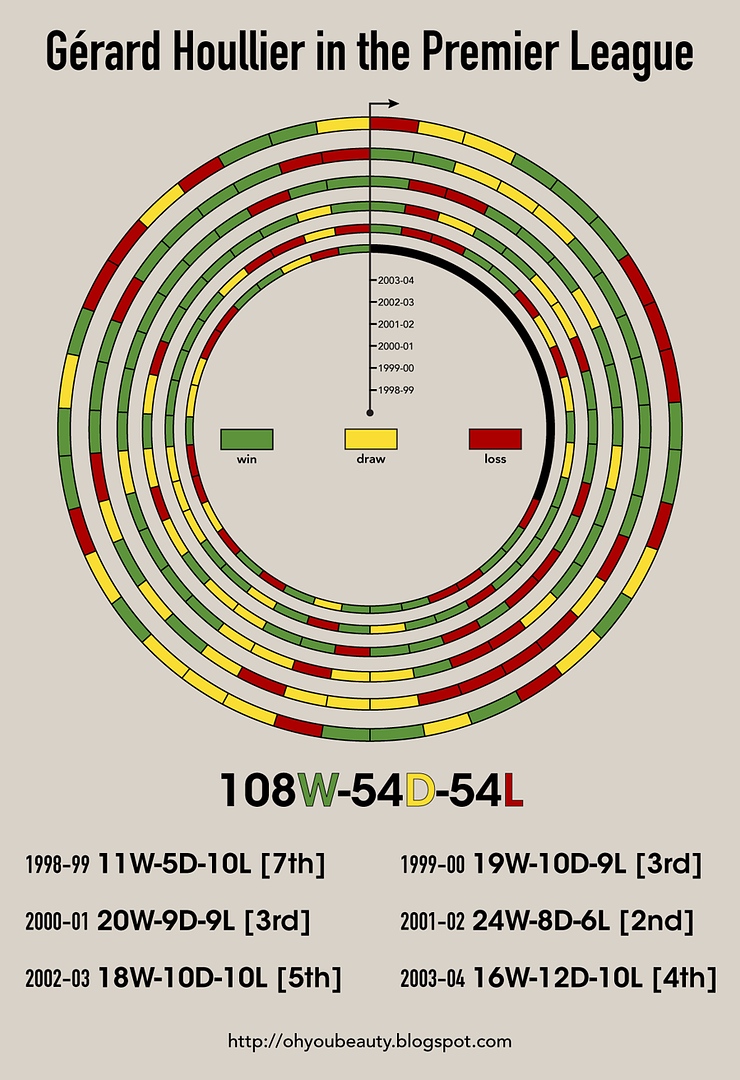
Benitez and Houllier in the Premier League [Infographic]

I've been trying to come up with different ways to visually represent results. I like this one.


That both Benitez and Houllier were in charge for six seasons allows for a straightforward comparison, even if we don't count the first 12 games of 1998-99 because of the ill-fated Evans/Houllier managerial pairing. Houllier's win percentage was 50%, Benitez's 55%. Both finished 2nd once, 3rd twice, 4th once, 5th once, and 7th once.

I'd like to direct your attention to a couple of areas.

First, the lower portion of Houllier's – and, to a lesser extent, Benitez's – wheel. There's an argument for a winter break right there, especially the results from 2001-02 and 2002-03. From the 15th match of the season through the 23rd, 54 matches over Houllier's six years, Liverpool won just 19, losing 18 and drawing 17, a win percentage of 35% compared to Houllier's 50% overall. Benitez's record during the winter months is better, but there's still the greatest concentration of draws in that part, especially during the '08-09 campaign – draws which directly led to Liverpool failure to win the league.

However, both managers had an outstanding record during the run-in. Benitez's sides suffered just four losses in the last seven matches during his six campaigns: 28 wins, 10 draws, 4 losses – winning 67% of the matches, dropping just 32 of 126 points. And half of those losses came in 2006-07, when Liverpool used a weakened line-up in the league while focusing on the Champions League Final – something Neil Warnock still complains about.

Houllier's results during that frame weren't quite as impressive, especially in 1999-02 and 2003-04, but there are still far more wins than draws or losses from, say, nine o'clock to midnight. His record of 13 wins, 1 draw, and 1 loss to close out 2001-02 is what led to Liverpool's second place finish that season, spoiled by the clutch of losses and draws during the winter when Liverpool dropped from 1st to 5th. But then Liverpool went out and bought Diouf, Diao, and Cheyrou, finished 5th the next season, and the rest is history.

Here's hoping Brendan Rodgers lasts six seasons (at least), and can replicate some of the heights hit by either of these managers.

Wednesday, July 4, 2012

LFC Summer Signings Since '04-05

Liverpool haven't signed anyone yet! Sigurðsson chose Spurs over Liverpool! Everyone freak out!

Well, maybe.


Liverpool have signed 51 first-team players since 2004-05, not counting youngsters who never played a first team game such as Németh and San José. 14 of those 51 – 27% – were signed before July 4.

In fact, Liverpool have signed someone on or before July 4 every summer since 2004. Even in Benitez's first season, when Cisse was already wrapped up before Benitez was. Even in 2009, when Liverpool had less than zero money, and 2010, when Liverpool had less than zero money and before Hodgson officially became manager, thanks to Rafa's parting gift of Jonjo Shelvey.

Incidentally, July 4 has also been Liverpool's busiest business day over the last eight summers, with six players officially signed on that date: Barragán, Reina, and Zenden in 2005; Paletta in 2006; Torres in 2007; and Dossena in 2008. Two out of six ain't bad. Okay, maybe it is.

To be fair, Liverpool have excuses, some actually valid. It's understandable that the club are reticent to break their wage structure for Sigurðsson, if that's truly the reason he went to Spurs. The Euros, and the typical lack of business during a major tournament, have made it harder for the new manager to evaluate the current players, let alone make signings. Today was the first day Rodgers met with the squad, and that obviously doesn't include players who went to the Euros.

Still, it's less than reassuring when nearly all of Liverpool's rivals have started their summer business. Hell, even Everton's signed someone. At least the club are all geared up to release the third kit at midnight. Priorities…

All signing dates via the invaluable, irreplaceable LFCHistory.net.

Monday, June 4, 2012

Liverpool FC and the English National Team


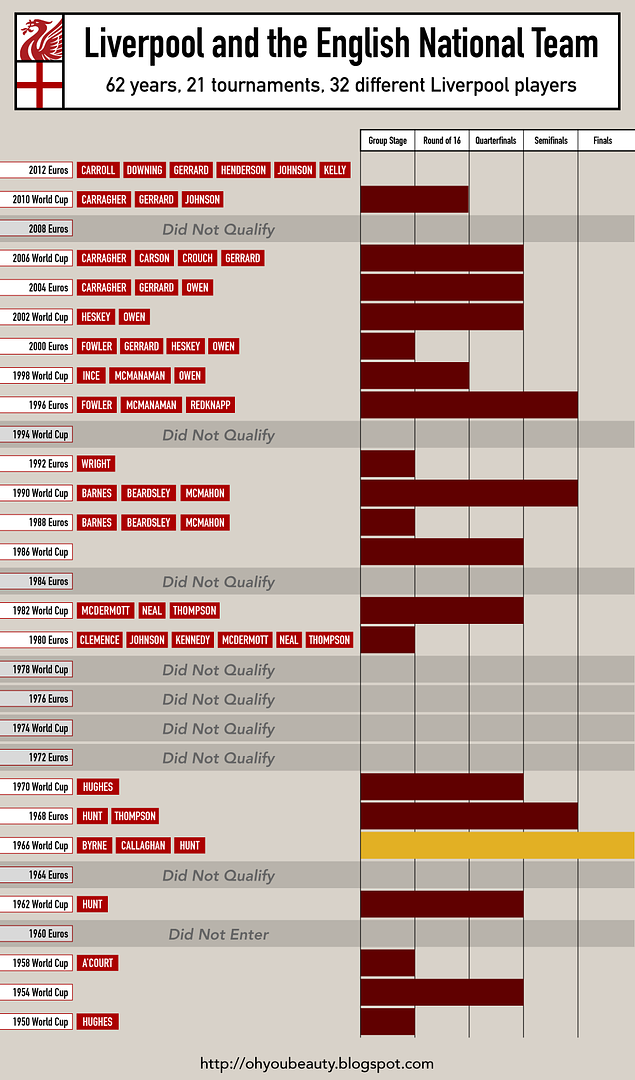
• England have qualified for 21 of the 30 World Cups (13 of 16) and European Championships (8 of 14) held since 1950. Liverpool had at least once player in 19 of the 21 England squads. On average, Liverpool have had 1.92 players involved in an England World Cup squad and 3.5 in a Euros squad.

• One of those two tournaments where Liverpool had no players in the England squad was the 1954 World Cup, which took place just after the last time Liverpool were relegated. The other was the 1986 World Cup. In contrast to 1954, Liverpool won the league prior to that tournament. To be fair, Steve McMahon (first cap in 1988), Sammy Lee (last cap in 1984), and Paul Walsh (last cap in 1984) were the only English internationals at the club then (both Alan Kennedy and Phil Neal left Liverpool during the '85-86 season).

• I can't help but think Hodgson's taking so many Liverpool players as a form of punishment. With Kelly added to the England squad on Sunday due to Cahill's fractured jaw, the 2012 Euros squad equals the record for most Liverpool players in an England squad, set in the 1980 European Championships. Just as in 1980, no club has more in the English squad. Granted, Liverpool won the 1979-80 league championship while finishing 8th this season, so that probably doesn't bode well for the Three Lions. If you're wondering, England finished third in its group in the eight-team 1980 Euros, behind Belgium and Italy (but ahead of Spain!). All six Liverpool players featured in the first match, a 1-1 draw against Belgium, but only Phil Thompson played in all three matches.

• Liverpool have been the best-represented club six times: joint-top four times (2006 with Chelsea, 2000 with Manchester United, 1982 with Ipswich and Manchester United, and 1966 with West Ham and Manchester United), and with the outright most England players in the 1980 and 2012 Euros.

• Technically, England's 1982 World Cup campaign ended at the Second Group Stage, with 12 sides remaining, rather than the quarterfinals, finishing second in their three-team group behind West Germany. But I really didn't want to create a "Second Group Stage" category for just that tournament.


(ht Inter Leaning for the photo, from the 1966 World Cup Final)

Thursday, May 24, 2012

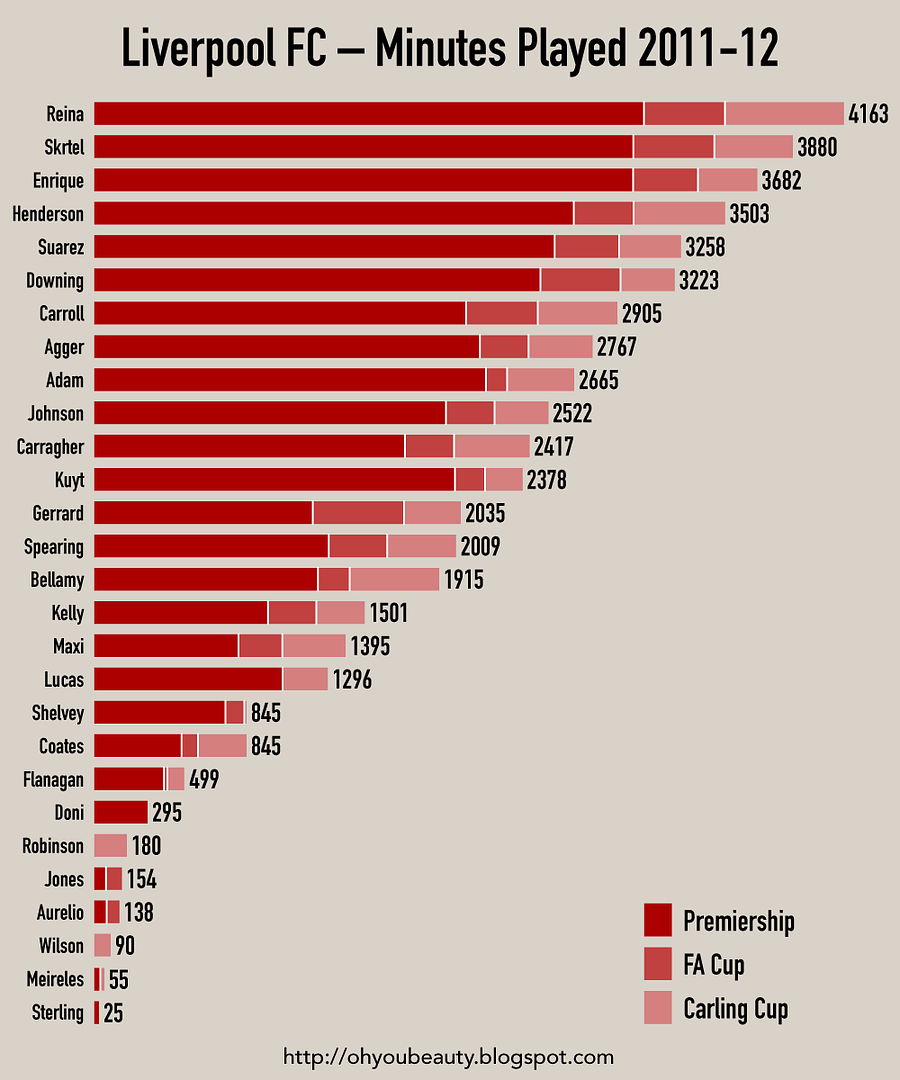
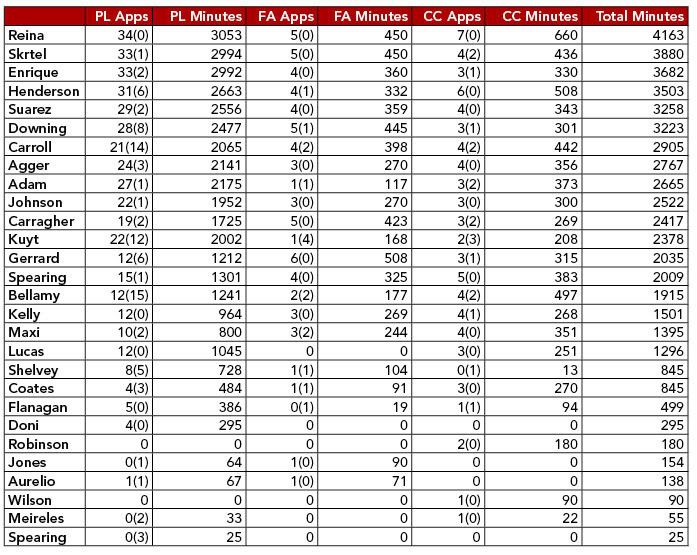
Minutes Played 2011-12

Had a request following the last graphic, which listed each players' total appearances, to break it down into minutes played. Appearances can be deceiving, after all. Ask and ye shall receive (sometimes).


Total possible minutes were 3420 in the Premier League, 540 in the FA Cup, and 660 in the Carling Cup.

Notable miscellany:

• Unsurprisingly, two defenders and the starting goalkeeper played the most minutes. It's no surprise to see Reina lead in minutes played for the Premiership and Carling Cup – he was the only player to play all seven Carling Cup matches and the maximum minutes possible in any competition. Both he and Skrtel played every minute in the Premier League last season. This was the first season since 2006-07 where Reina didn't play every Premier League minute.

• It was, however, slightly surprising to see Gerrard lead in minutes played for the FA Cup, the only player to start all six FA Cup ties. Carroll and Downing were the only others to appear in all six matches; Downing started five, Carroll four.

• Carragher played the fifth-most minutes in that competition, behind Gerrard, Reina, Skrtel, and Downing. However, he was 12th in Premier League minutes played and 16th in Carling Cup minutes played.

• Kuyt and Bellamy had the joint-most substitute appearances in all competitions, with 19. Carroll was just one behind, with 18 appearances off the bench.

• Despite being injured since the end of November, Lucas played just 99 minutes less than Maxi, with both making the same number of Premier League appearances. This should bother you. It bothers me.

• Somehow Shelvey and Coates played the exact same amount – 845 total minutes. I just found that odd.

Sources:
• Premiership totals from LiverpoolFC.tv statistics
• Cup totals added together from LFCHistory.net match reports

Monday, May 21, 2012

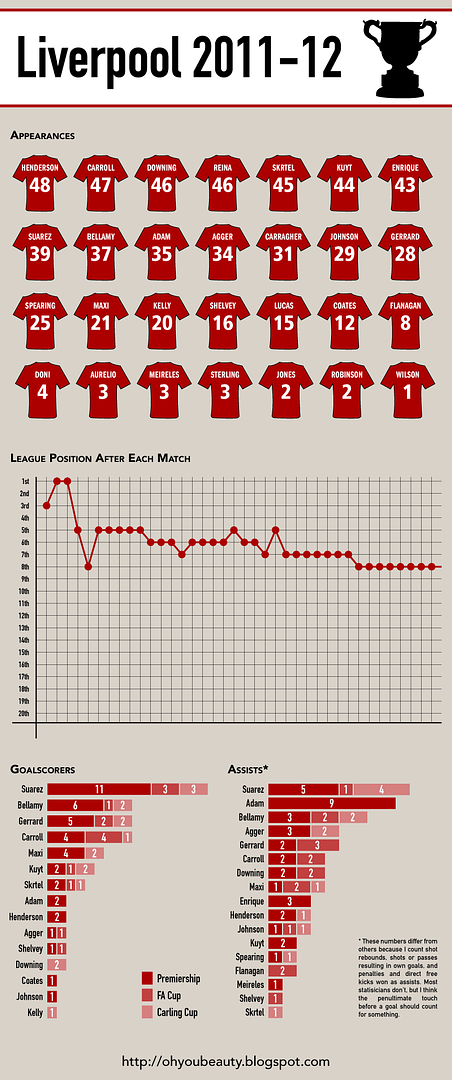
Liverpool Stats 2011-12

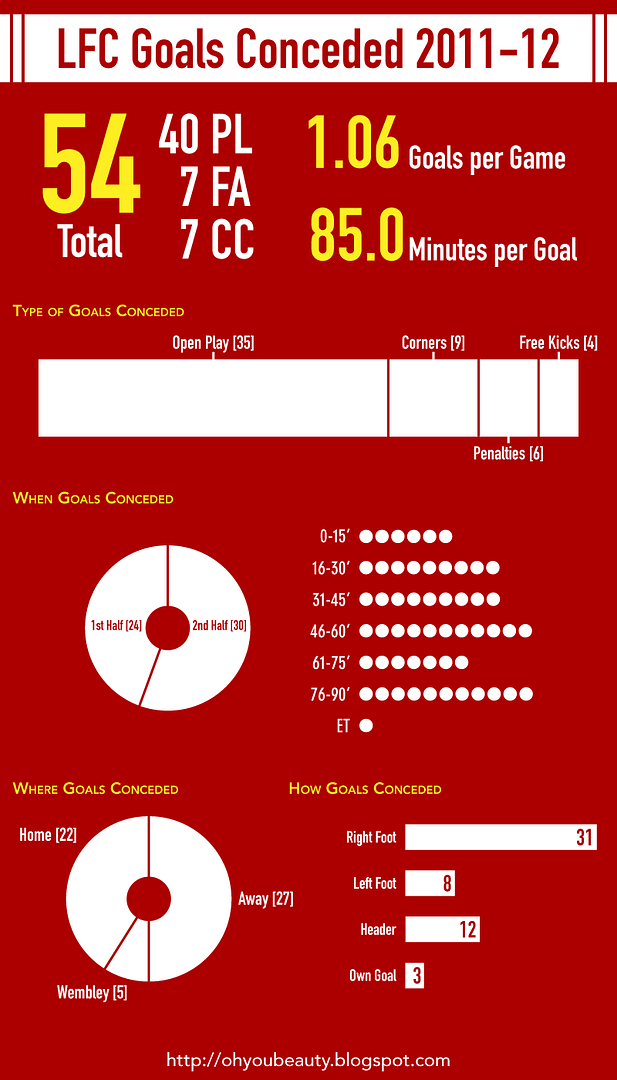
More season-long statistics in graphic form, similar to those about goals scored and conceded published last week. Because no matter how painful the 2011-12 season was, this is still more fun than baseless and mindless speculation about the new manager and/or future of the club.


As often, all statistics from LFCHistory.net except for "assists," which are explained in the graphic.

Tuesday, May 15, 2012

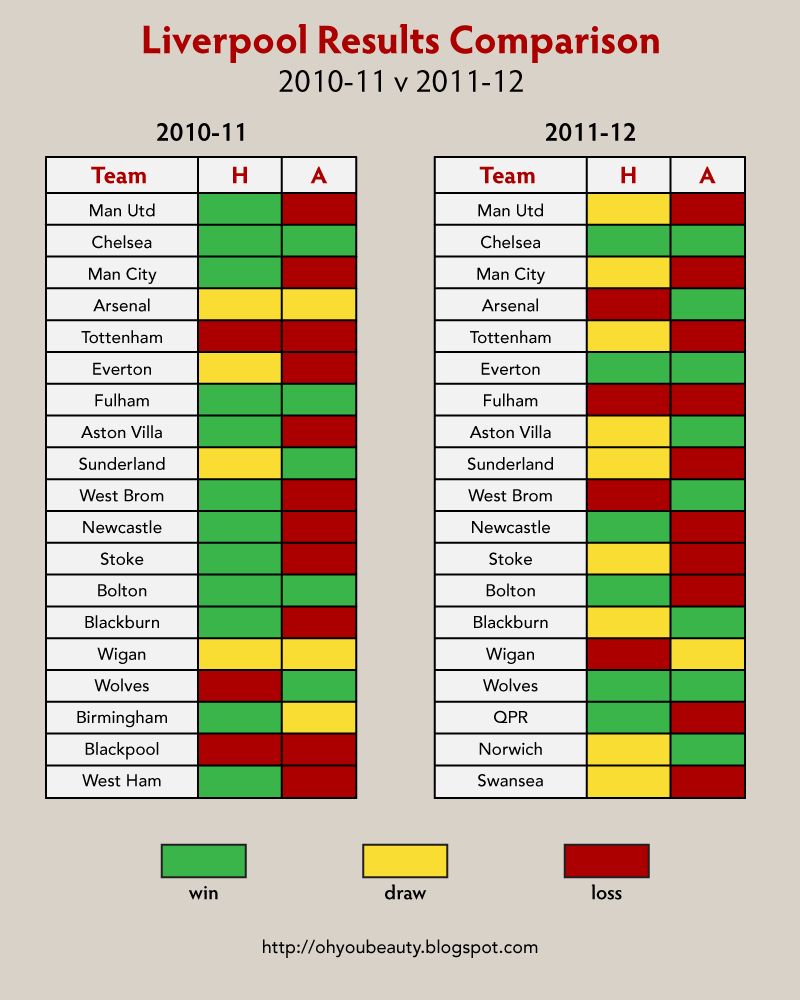
Results Comparison 2011-12 (and bonus graphic)


For comparison, here's last year's version.

Fairly similar, horrific results, but more home draws leading to fewer points. Huzzah!

versus club:
• United (1st --> 2nd) = -2
• Chelsea (2nd --> 6th) = 0
• City (3rd --> 1st) = -2
• Arsenal (4th --> 3rd) = +1
• Tottenham (5th --> 4th) = +1
• Everton (7th --> 7th) = +5
• Fulham (8th --> 9th) = -6
• Villa (9th --> 16th) = +1
• Sunderland (10th --> 13th) = -3
• West Brom (11th --> 10th) = 0
• Newcastle (12th --> 5th) = 0
• Stoke (13th --> 14th) = -2
• Bolton (14th --> 18th) = -3
• Blackburn (15th --> 19th) = -2
• Wigan (16th --> 15th) = -1
• Wolves (17th --> 20th) = +3
• Relegated/Promoted 1 (Birmingham 18th --> QPR 17th) = -1
• Relegated/Promoted 2 (Blackpool 19th --> Norwich 12th) = +4
• Relegated/Promoted 3 (West Ham 20th --> Swansea 11th) = -2

Better against Arsenal, Tottenham, Everton, and one of the relegated/promoted sides. Worse against almost everyone else.

versus league place:
• vs 1st = 3 to 1 = -2
• vs 2nd = 6 to 1 = -5
• vs 3rd = 3 to 3 = 0
• vs 4th = 2 to 1 = -1
• vs 5th = 0 to 3 = +3
• vs 6th = n/a to 6 = (0 combined with 8th)
• vs 7th = 1 to 6 = +6
• vs 8th = 6 to n/a = (0 combined with 6th)
• vs 9th = 3 to 0 = -3
• vs 10th = 4 to 3 = -1
• vs 11th = 3 to 1 = -2
• vs 12th = 3 to 4 = +1
• vs 13th = 3 to 1 = -2
• vs 14th = 6 to 1 = -5
• vs 15th = 3 to 1 = -2
• vs 16th = 2 to 4 = +2
• vs 17th = 3 to 3 = 0
• vs 18th = 4 to 3 = -1
• vs 19th = 0 to 4 = +4
• vs 20th = 3 to 6 = +3

Better against the three places directly above Liverpool in the table and, surprisingly, those at the very bottom. Otherwise, again, worse against the majority, both the clubs at the top of the table and the vast middle class of the league which Liverpool now sits among.

---


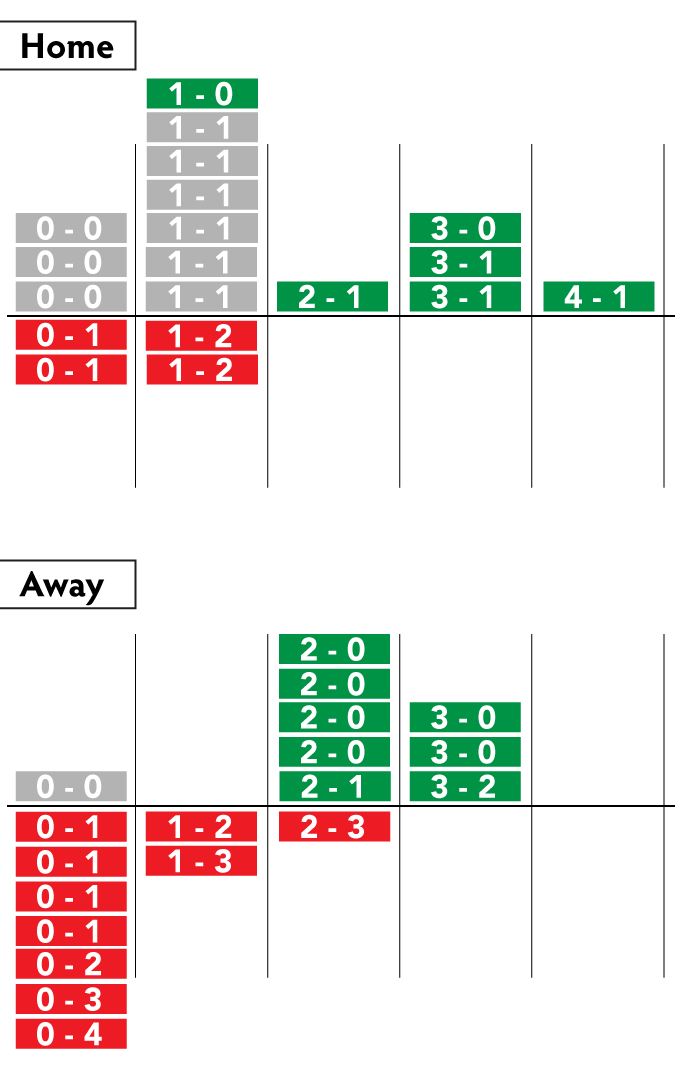
Another repeat from last season, as it seems helpful to organize results in this fashion. Unfortunately, since Liverpool scored far too few goals, it's not necessarily fun to look at said results in this fashion.

Some quick thoughts:

• Hey, at least Liverpool were better away from home this season! Let's not worry about how Liverpool's home record compares, though. Also, no points awarded for saying 'there was nowhere to go but up' because, seriously, don't be that guy.

• Look at all those draws. Actually, don't. It's depressing.

• Liverpool failed to win away when scoring just once. In fact, Liverpool scored just one away from Anfield twice in 18 games. The Reds were held scoreless in eight (one draw, seven losses), scored twice in six (five wins, one loss), and scored three in three (three wins). Odd.

• Last season, this graphic took up six columns. Just saying.

Wednesday, May 9, 2012

Painting the Woodwork


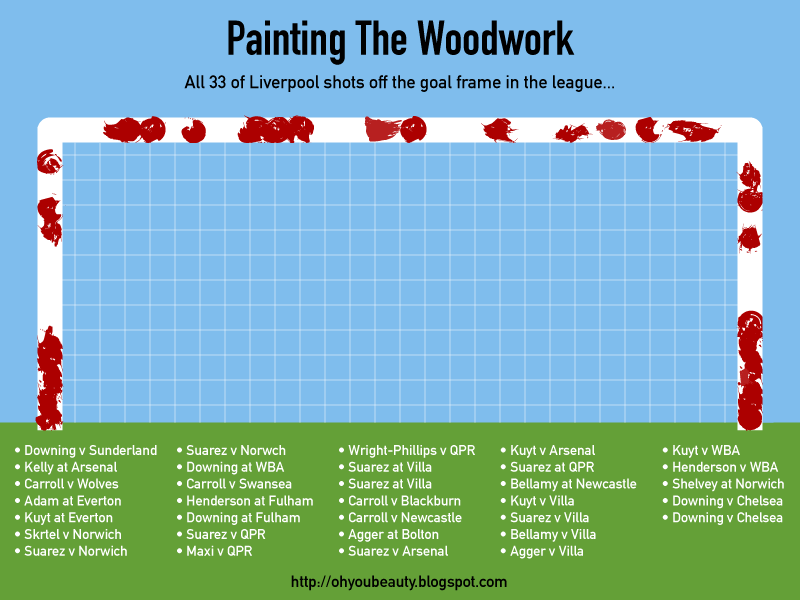
As many have noted since yesterday, Downing's two strikes against the woodwork bring Liverpool's league total to 33 for the season, a seemingly egregiously large number. Rubbing salt in the wounds, after the 0-1 loss to West Brom, Opta Joe noted that Liverpool would be fourth in the league if all the shots which hit the frame were goals. 10 of the 33 came in five of Liverpool's frustrating home draws, so there's 10 points right there.

The scapegoat list: Suarez 8; Downing 5; Carroll, Kuyt 4; Agger, Bellamy, Henderson 2; Adam, Kelly, Maxi, Shelvey, Skrtel 1. And one by Wright-Phillips for QPR in the 1-0 home match. 19 different Liverpool players have taken at least one shot in the league this season. 12 hit the post at least once. Coates, Gerrard, and Johnson are the only Liverpool players to have scored in the league without hitting the woodwork.

As distribution goes, it's fairly evenly weighted. 13 off the crossbar, 11 off the right post, and 9 off the left post. 8 of the 11 which hit the right post were aimed at the bottom half of the goal, 6 of 9 for the left post, showing that Liverpool consistently shoot low into the corner, which is fairly common and supported by these analyses from EPL Index and The Tomkins Times. Those which hit the crossbar were scattered across its length.

Shot placement data taken from StatsZone, this YouTube video, other random match highlights, and my admittedly faulty memory.

Thursday, May 3, 2012

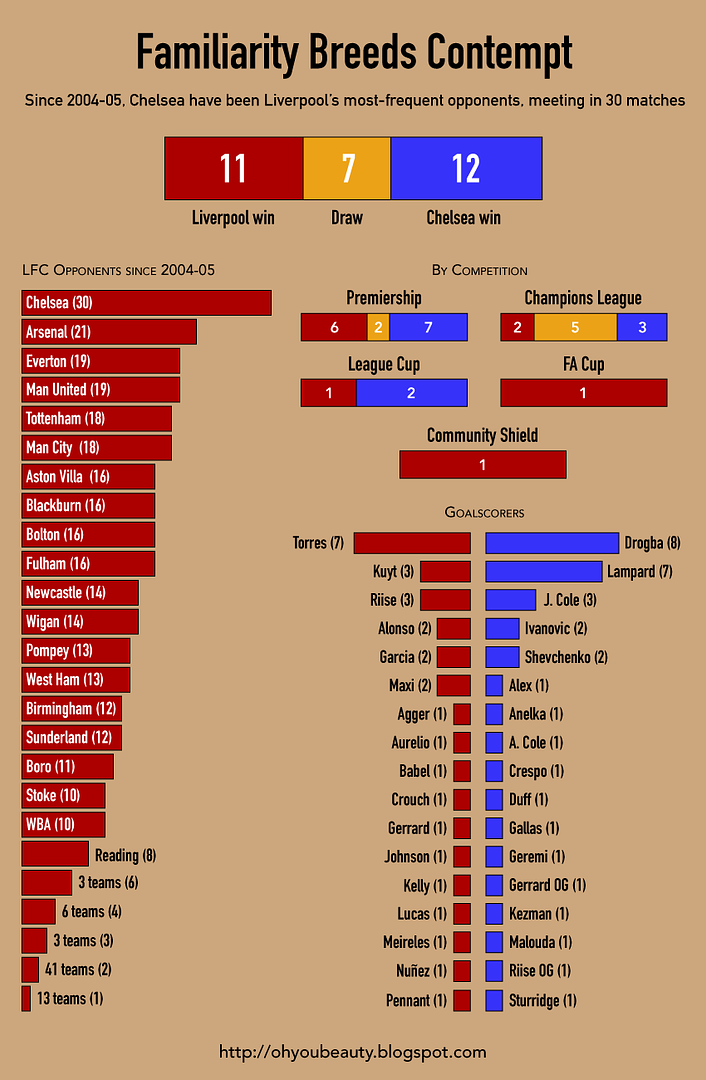
Familiarity Breeds Contempt

Similar to this Everton infographic, made prior to the FA Cup semi-final. But less comforting.

As usual, click the image to open in a new window.

Wednesday, April 18, 2012

Jamie Carragher and Defensive Positioning

Consider this an addendum to Noel's depressingly unsurprising post on Liverpool's defensive statistics with and without Carragher over at Liverpool Offside.

The numbers speak for themselves, but I've seen multiple people (not in Noel's post, by the way) credit Liverpool's inferior record with Carragher to Liverpool having to play a deeper back line thanks to Carra's notorious lack of pace. It's become something of a pet peeve of mine, because answers usually aren't that easy.

So, using the available average position diagrams from the Daily Telegraph match reports [they're missing v QPR (without Carra), v Villa (with Carra), and at Blackburn (without), because they're the Daily Telegraph and refuse to make anything easy or sensical], I thought I'd see if that was the case.


The fullbacks seem to get forward slightly more without Carragher, especially on Carragher's side, but not incredibly significantly. All in all, the charts look relatively similar expect for the white-outlined circles denoting where Carragher was. So let's get rid of the fullbacks.


That's better. And yep, looks deeper. But, again, not as much as I expected. There's a wider range of average center-back positions without Carragher in the line-up, but more interesting than how deep they play is how close together they are. I suspect having both center-backs nearer to one another, which suggests they're working better as a unit, is more meaningful than how deep either defends.

There were two matches where Carragher played notably deeper than his defensive partner: against Bolton and Wolves. Liverpool won both. The deepest Liverpool's center-backs played came at Chelsea, without Carragher in the line-up; Skrtel's average position is nearly inside the penalty box. And yes, Liverpool won that game too. So please, let's stop the focus on how "deep" Liverpool's defense is. The above suggests that isn't the alpha or omega.

Carragher has a tendency to exacerbate multiple problems in Liverpool's defense. That he's played so often borders on the unforgivable, even if there are excuses for individual games (it's Everton, it's away from Anfield, etc, etc). But crediting problems to a single factor, such as others having to play deeper because of said lack of pace, is far too simplistic. And might not even be true. As with everything else in football, defensive positioning depends on multiple factors – the other defenders on the pitch and the opposition, most notably. Often, it's not how deep Liverpool's defense plays. Who plays may well be, though.

Wednesday, April 11, 2012

50 Years of Merseyside Derbies


There have been 217 Merseyside derbies in total. I limited this remembrance to the previous 122, those played in the last 50 years. Which is actually a handy dividing line, as Liverpool and Everton only met once between 1951 and 1962, in the '54-55 FA Cup (which Liverpool won), because of Everton then Liverpool's relegation to the Second Division. Since '62-63, the two clubs have played at least twice per campaign, with 22 cup ties joining the two seasonal fixtures.

And one club is obviously better than the other.

54 wins, 41 draws, and 27 losses pretty much speaks for itself. Liverpool have a better record in four of the six decades, and by some distance in the 1970s, 1980s, and 2000s. The only competition in which Liverpool doesn't have a winning record over Everton is the season-opening Charity Shield, where both have one win, one loss, and one draw (each club had custody of the trophy for six months following the draw, if you're wondering).

Liverpool have also faced Everton in four cup finals – 1981 and 1984 in the FA Cup, 1984 in the League Cup, and 1986 in the ScreenSport Super Cup (don't ask) – and won all four, albeit with a replay in the '84 League Cup Final. The Reds also won both FA Cup semi-finals against the Blues, in 1971 and 1977. In total, Liverpool have won more matches, scored more goals, kept more clean sheets (48 to 43), and incurred fewer red cards in Merseyside derbies.

It's too bad the past isn't perfect proof of the future. Although that might well be a good thing since Liverpool have failed to win the last five derby cup ties.

As usual, most stats from the irreplaceable LFCHistory.net, without which I wouldn't be able to do approximately half of the infographics I've created. Red card totals from Liverweb and the Merseyside Derby Wikipedia page (don't laugh), all between 1979 and 2011. In theory, there could have been red cards in the derbies from 1962-78, but I couldn't find evidence of it.

Wednesday, April 4, 2012

2011-12 Turning Points


Lucas Injury
• 1.77 points per game before, 1.05 after [-0.62 PPG]
• 1.31 goals per game before, 1.05 after [-0.26 GPG]
• 0.92 goals conceded per game before, 1.11 after [+0.19 GCPG]

Suarez Suspension
• 1.72 points per game before, 1.40 during [-0.32 PPG]
• 1.17 goals per game before, 1.40 during [+0.23 GPG]
• 0.78 goals conceded per game before, 1.40 during [+0.62 GCPG]

Carling Cup Final and Agger Injury
• 1.56 points per game before, 0.50 after [-1.06 PPG]
• 1.16 goals per game before, 1.17 after [+0.01 GPG]
• 0.92 goals conceded per game before, 1.67 after [+0.75 GCPG]

All three are terrifying, but the effects of the Carling Cup final hangover and, more importantly, Agger's injury are by far the scariest. Liverpool have only played six league matches since, but are averaging a point less per game and conceding 0.75 more goals per game. Having Johnson and Kelly absent for most of those certainly hasn't helped, but Agger is the the biggest miss. Skrtel may have been Liverpool's player of the season – at least before this recent stretch – but Daniel Agger is by far Liverpool's most important defender. As Bass Tuned to Red wrote earlier this week, Liverpool have conceded a league goal every 129.7 minutes with Agger on the pitch, and a league goal every 58.9 minutes when he has been absent. Yikes.

Lucas' injury is almost as significant. Liverpool's record in the 13 games prior to his injury: 6W-5D-2L. Liverpool's record in the subsequent 18: 5W-4D-9L. Fewer goals scored per game and more goals conceded, although it's slightly surprising to see a bigger difference in goals scored rather than conceded. But Lucas' as the metronomic base for Liverpool's attacks is just as important, if not more so, than Lucas as the tough tackling defensive midfielder.

Finally, Suarez's suspension. Five matches, from Newcastle at home through Wolves away, returning as a substitute against Tottenham. Liverpool actually scored more goals per game during the matches Suarez missed. Carroll started as a lone striker in three: the two matches where Liverpool scored three – wins against Newcastle and Wolves – as well as the 0-3 loss at City. Carroll and Bellamy partnered in the loss at Bolton, linking up for the lone goal, while Kuyt started up front in the 3-4-2-1 scoreless draw against Stoke. However, Liverpool's goals conceded tally rose dramatically during that span, mostly thanks to conceding three against City and Bolton, both featuring Liverpool's first choice back four of Johnson-Skrtel-Agger-Enrique. It's hard to credit that to Suarez's absence, but I suspect (without proof) that opponents are more hesitant to send multiple attackers forward with the ever-dangerous Uruguayan lurking off the shoulder of the last defender.

Missing key players for long to extra-long stretches isn't a good enough excuse for this season's horrors. Liverpool still scored too few goals, conceded frustratingly in aberrant draws, and found new and inventive ways to drop points before any of these three turning points. However, all three absences, as well as the post-Carling Cup letdown, do help explain the increasingly diminishing returns during this horror campaign.